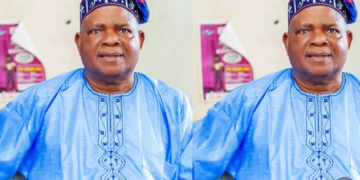
Vice President Kashim Shettima has said Nigeria’s path to lasting peace and development depends on leaders who place justice, unity and public welfare above personal power.
He specifically described the 16th Emir of Lafia, Justice Sidi Bage Muhammad I, as a model of the type of leadership Nigeria needs in every region.
Shettima stated this on Monday in Lafia, Nasarawa State, during the 70th Birthday and Valedictory Celebration of the royal father, describing him as a rare national figure whose life has been defined by integrity, scholarship, justice and service.
The Vice President who was on a one-day working visit to the state had a road, Kashim Shettima Road, and a hall named after him.
According to his spokesman, Stanley Nkwocha, Shettima said the Emir’s journey from the legal profession to the traditional institution offered Nigeria an important lesson on the value of disciplined, principled and people-centred leadership.
Justice Sidi Bage, he noted, had made his mark in the nation’s judicial system long before ascending the throne of his forefathers, noting that his service at the Supreme Court of Nigeria placed him among jurists entrusted with interpreting the foundations of the Republic.
“Long before the people of Lafia welcomed him to the throne of their ancestors, this remarkable son of the soil had already inscribed his name into the records of our national life.
“From the lecture halls of Ahmadu Bello University to the corridors of the Nigerian legal profession, he built a reputation upon the bedrock of integrity, scholarship, and an uncompromising fidelity to justice,” he stated
Shettima said the Emir did not abandon the discipline of the bench when he became a traditional ruler, but brought the same clarity, fairness and steadiness of character to the service of his people.
“When he ascended the throne of his forefathers, he did not abandon the discipline of the bench. He brought it with him, and the people of Lafia have been the better for it,” he said.
Shettima also praised the Emir’s role as Chairman of the Nasarawa State Council of Chiefs, saying his leadership has helped strengthen harmony in a state marked by diversity of languages, faiths and traditions.
He said the Emir had championed culture, supported religious institutions, protected local heritage and promoted peaceful coexistence, thereby proving that traditional institutions remain critical to national unity.
“He has shown that traditional authority, when exercised with wisdom, remains among the most powerful instruments of national cohesion that we possess,” the Vice President said.
Speaking further, Shettima noted that Nigeria’s future would be stronger if every region and community had leaders who choose peace over provocation and service over personal gain.
His words: “I have come to believe, after years of reflection upon the condition of our country, that Nigeria will rise to the fullness of her promise on the day when every region, every state, and every community is blessed with leadership of this calibre.
“Where there are leaders who heal rather than divide, who build rather than burn, and who serve rather than seize, the greatness of this nation ceases to be an aspiration and becomes a destiny we author with our own hands.”
The Vice President also commended the Governor of Nasarawa State, Engr Abdullahi Sule, for what he described as the creation of an environment of stability, tolerance and development across the state.
He added that President Bola Tinubu’s administration, through the Renewed Hope Agenda, recognised the importance of collaboration between traditional rulers and elected authorities in building national renewal.
He said the Emir’s life and reign represent the kind of moral authority and stabilising leadership required to hold diverse communities together.