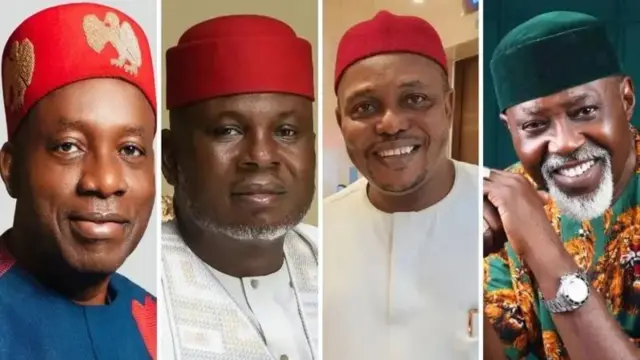
When the Independent National Electoral Commission (INEC) declared Governor Chukwuma Charles Soludo the winner of the November 8, 2025, Anambra State governorship election, there was little surprise across the state.
Soludo, who ran on the platform of the All Progressives Grand Alliance (APGA), sweept all 21 Local Government Areas of the state, after polling a commanding 422,664 votes, far ahead of his closest rival, Prince Nicholas Ukachukwu of the All Progressives Congress (APC), who garnered 99,445 votes. The Young Progressives Party (YPP) came third with 37,753 votes, while the Labour Party’s George Moghalu secured 10,576 votes. The African Democratic Congress (ADC) trailed with 8,208 votes.
The results were not a surprise. Soludo’s win was expected, not because the opposition had no ideas, but because they were too divided and distracted to mount a serious challenge. The outcome shows clearly that when opposition parties fight among themselves instead of focusing on voters, the ruling party gains an easy victory.
Labour Party: From Momentum to Meltdown
Just two years earlier, the Labour Party had captured national attention with the surge of the “Obidient” movement, led by its presidential candidate, Peter Obi. That wave of enthusiasm had inspired many young Nigerians to believe that a new political force was possible. But as shown in the Anambra election, the party’s internal chaos has drowned out that optimism.
Factions loyal to different national chairmen tore the party apart. The pro-Julius Abure group and the pro-Nenadi Usman group each produced their own candidates, confusing even loyal supporters. The courts were dragged into the mess, but by the time any clarity came, the campaign season was over.
In many local governments, Labour Party supporters confessed that they did not even know who their real candidate was. A voter from Nnewi South captured the frustration succinctly: “We were ready to vote Labour, but no one came here to campaign. They were fighting themselves while Soludo was busy working.”
The endless court cases, lack of structure, and poor grassroots organisation ensured that the Labour Party’s performance in Anambra was nothing short of disastrous. The party, once seen as the future of Nigeria’s opposition, became a victim of its own ambition and disunity.
PDP: The Fall of a Political Giant
For the People’s Democratic Party (PDP), the story was one of slow but steady decline. Once hailed as Africa’s largest political party, the PDP has been reduced to a house divided against itself, weakened by internal strife and power struggles. Its failure in Anambra was not unexpected, it was the result of years of unresolved leadership crises.
The party’s inability to attract credible aspirants during the nomination stage signalled trouble from the start. Many PDP members refused to purchase the nomination forms, citing distrust in the leadership and uncertainty about the fairness of the primaries. In the end, only one aspirant, Chief Jude Ezenwafor, an Abuja-based real estate developer, showed interest.
Behind the scenes, the PDP was at war with itself. At the national level, a fierce battle between the Governors Forum and their loyalists and those aligned with the Minister of the Federal Capital Territory, Nyesom Wike, further fractured the party. Wike’s allies, such as Senator Samuel Anyanwu, faced suspension and counter-suspension from rival factions. The crisis escalated to the courts, where injunctions and counter-orders became the order of the day.
When policemen fired tear gas at the PDP national secretariat during a leadership standoff, it became clear that the party that once held Nigeria’s presidency for sixteen years had become a caricature of its former self.
The irony, however, is not lost on Nigerians. The same internal conflicts that once consumed the PDP are now threatening to destroy the Labour Party. Both parties, the supposed pillars of opposition, have become their own worst enemies.
ADC: A Party with Potential but No Power
Amid the chaos of the larger opposition, the African Democratic Congress (ADC) quietly fielded its candidate, John Nwosu. Despite being backed by a coalition of smaller political movements, the ADC struggled to make any meaningful impact, polling just 8,208 votes.
The ADC’s problem was not division but invisibility. Without elected officials, a solid grassroots network, or substantial funding, the party lacked the machinery to compete.
Vote Buying: The Shadow of the Ballot
The Anambra election also exposed the ugly persistence of vote buying, a stain that continues to weaken Nigeria’s democratic integrity. Reports indicated that voters were offered cash ranging from ₦5,000 to ₦30,000 to vote for certain candidates. Some party agents were even caught on camera distributing money openly near polling units.
Labour Party’s George Moghalu lamented on national television that he lost his polling unit because he refused to engage in vote buying. “They have too much money to buy votes. My people fell because many are poor,” he said. His words echoed the harsh reality — poverty has become a political tool, and many citizens see elections as a rare opportunity to collect immediate financial relief, rather than shape their future through the ballot box.
Soludo’s Solution Strategy
While the opposition was lost in confusion, Soludo ran a focused, structured, and well-funded campaign. He leveraged his incumbency, highlighting visible achievements — from road infrastructure to education reforms and youth empowerment projects. APGA’s strong grassroots presence across Anambra’s 21 local governments gave him an unmatched advantage.
On election day, APGA agents were stationed in virtually every polling unit, coordinating logistics, mobilising voters, and monitoring vote counts. Meanwhile, opposition parties struggled to deploy polling agents across all wards. In many areas, the PDP and LP had no representatives at all.
Soludo’s triumph was therefore not just a function of popularity but a demonstration of political organisation. The ruling APGA combined governance and strategy to secure victory, while the opposition parties were busy fighting themselves.
Analysts Warn of 2027 Repeat
Political analysts are already drawing lessons from the Anambra election. Nduka Odo, a public affairs analyst at Peaceland University, Enugu, believes that if the opposition continues on its current path, the 2027 general elections will be a repeat of what happened in Anambra.
“The election has shown that the opposition in Nigeria is still very weak. If they don’t fix their internal crises and work together, they will continue to lose. Since Peter Obi left APGA, the party has remained strong in Anambra, while the other parties have failed to build anything close to that structure,” he said.
Odo’s warning highlights a larger national concern: the absence of a credible opposition means that the ruling party, the All Progressives Congress (APC), faces little resistance ahead of 2027.
Opposition in Disarray, Democracy at Risk
Today, Nigeria’s opposition landscape is in tatters. The PDP is consumed by internal wars, the Labour Party is paralysed by court battles, and the ADC lacks the capacity to mount a serious challenge. The result is a political environment increasingly dominated by the APC, whose grip on national and state politics grows tighter by the day.
President Bola Tinubu’s open mockery of the opposition earlier in the year reflected the confidence of a ruling party with no serious rivals. “It is indeed a pleasure to witness you in such disarray,” Tinubu told opposition leaders during a National Assembly address. His words, though laced with sarcasm, underscore the danger of Nigeria sliding toward one-party dominance.
The lack of a credible opposition is not just a political problem — it is a democratic crisis. When power is concentrated in one party, accountability suffers, corruption grows unchecked, and citizens lose faith in the electoral process. Already, voter turnout in recent elections has been dismally low, with many Nigerians expressing apathy and disillusionment.
A democracy without a strong opposition is like a bird trying to fly with one wing — it may rise for a moment, but it cannot soar. The opposition parties must therefore rediscover their purpose, rebuild their structures, and reconnect with the people. They must shift from being platforms for personal ambition to institutions of governance and accountability.
If they fail to do so, the 2027 elections will not be a competition of ideas or leadership, but a coronation for those already in power. Nigeria’s democracy thrives only when citizens have genuine choices. The opposition must offer those choices again.
#SoludoVictory #AnambraElection #2027Elections #OppositionInDisarray #PDP #LabourParty #ADC #APGA #NigeriaPolitics #DemocracyInDanger #Iwitnesslive