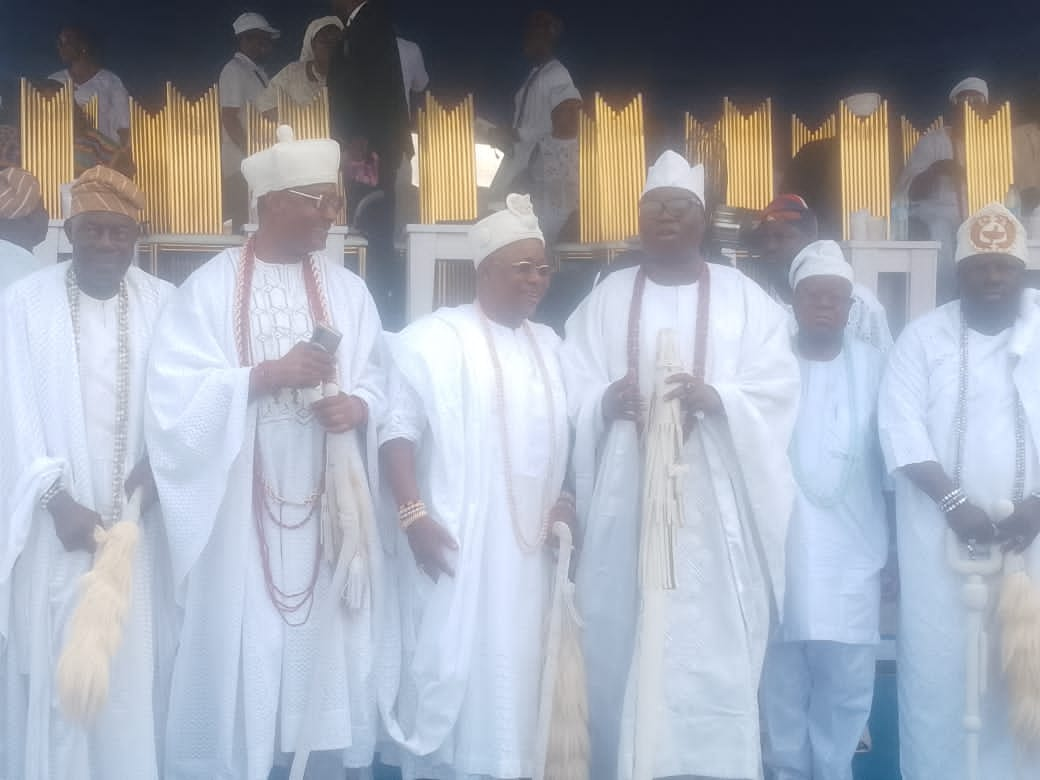
The Aare Ona Kakanfo of Yorubaland and Chief Promoter of the Olokun Festival Foundation (OFF), Iba Gani Abiodun Ige Adams, has urged the Federal Government to move tourism from the residual to the concurrent legislative list to enable federal and state governments to collaborate more effectively in developing the sector.
Adams made the call on Tuesday at the 24th edition of the Olokun World Festival, held at Kakanfo-Falola Beach, Badagry, Lagos, where he advocated policies to attract tourists, improve infrastructure, strengthen security and encourage investment in Nigeria’s tourism industry.
He argued that placing tourism on the concurrent legislative list would enable states to work more closely with the Federal Government and its agencies to harness the country’s tourism potential.
“I want to use this opportunity to advise the Federal Government that, much as tourism is on the residual list, they should make policy moves to take tourism to the concurrent legislative list.
“This will enable states to productively work together with the Federal Government and its agencies to fully harness the tourism potentials of our country,” he said.
The Yoruba cultural leader said the proposed change could also give states greater opportunities to promote their tourism destinations and facilitate international visitors.
“Approving visas for tourists should not be restricted to Federal Government influence,” Adams said, arguing that states should be able to engage relevant diplomatic missions to ease visa processes for visitors interested in exploring their attractions.
He also urged state governors to prioritise tourism ministries and appoint commissioners with relevant professional backgrounds and experience.
“I also want to call on state governors to prioritise Ministries of Tourism. Anybody who the governors want to appoint to lead the ministry as a commissioner should be someone who has the background and experience of tourism, not just anybody in the name of satisfying political demands,” he said.
Adams described tourism as an underdeveloped economic opportunity for Nigeria, noting that countries with significant oil resources were increasingly investing in tourism to diversify their economies.
“Tourism is a goldmine that Nigeria is yet to tap,” he said, citing the United Arab Emirates, Qatar and Saudi Arabia as examples of countries investing in the sector.
He urged the government to address insecurity, infrastructure deficits and the high cost of electricity, which he said affected the hospitality industry and made hotel accommodation expensive for many Nigerians.
According to him, reducing operating costs for hotels could make accommodation more affordable, encourage domestic travel and attract international visitors.
“One of the main factors that impede people from going to hotels to enjoy themselves is the high cost of the hotels.
“Hoteliers now complain regularly that the amount of money they pay for electricity is getting out of control,” he said.
The Olokun Festival promoter called for a broader approach to national development that would recognise tourism and leisure alongside business activities.
“Presently, Nigeria is being run as a business destination. I want to implore our governments to let us add leisure destination into the nomenclature.
“A country interested in developing should be run both as a business destination and leisure destination. This will help us a lot; a lot of people will come into this country to spend their foreign currency,” he said.
He said improved security and road infrastructure could encourage Nigerians to travel within the country for holidays instead of limiting their journeys to business or other essential activities.
“With good security and road infrastructure, domestic tourism will improve. People will leave Lagos for Bauchi to spend holidays. People will travel across places like Calabar, Owerri, Asaba and Warri just to change environment and spend holidays,” he said.
Adams also appealed to the Federal Government to extend the ongoing reconstruction and upgrade of the Lagos-Badagry Expressway to the Seme border and expedite its completion.
He said improved road connectivity would make Badagry more accessible to tourists travelling from Lagos and neighbouring Benin Republic.
“I want to plead with the Federal Government to extend the road infrastructure upgrade up to the Seme border and hasten its completion.
“This will make it very easy for tourists coming from either way—from Lagos or Benin Republic—to access Badagry without difficulty. It will also further position Badagry as a prime location for major festivals and investments,” he said.
He expressed confidence that sustained support from the federal and state governments would help Badagry reclaim its position as one of Nigeria’s leading tourism destinations.
Adams said the town had experienced changes since the Olokun Festival was relocated there, adding that the annual celebration was designed to contribute to cultural awareness and economic activity.
He maintained that the festival was more than a cultural gathering, describing it as an economic opportunity for local businesses, artisans and entrepreneurs.
According to him, tourism activities associated with the festival could create employment, support small and medium-sized enterprises and stimulate investment in hospitality, transportation and entertainment.
Adams disclosed that the Olokun Festival Foundation was developing Kakanfo-Falola Beach as a major cultural tourism destination.
He said that the proposed facilities included a hotel, mini cinema, conference halls, gym centres, an Olympic-size swimming pool, a mini festival stadium and courts for lawn tennis, table tennis and beach soccer.
Plans were also underway to establish a museum at the site to preserve artefacts and document the history of Yoruba communities.
“This museum will also have a virtual counterpart online, allowing global access to Yoruba history and culture,” he said.
Adams projected that within four years, the site would become a major cultural tourism centre capable of attracting visitors from Nigeria, other West African countries, the Caribbean, Brazil and beyond.
He said the 2026 festival had attracted contingents from Benin Republic, Togo, Ghana, Côte d’Ivoire, France, the United Kingdom, Italy, Brazil, the United States and some Caribbean countries.
The festival promoter added that plans were at an advanced stage for the foundation to collaborate with festival organisers in Italy, Luxembourg, Germany and Brazil to take the Olokun Festival to those countries.
He said the international participation reflected the festival’s expanding reach and its potential to project Yoruba culture beyond Nigeria.
Beyond tourism and economic development, Adams described the Olokun World Festival as a platform for preserving Yoruba history, spirituality and cultural identity.
Welcoming royal fathers, cultural ambassadors and other guests to the grand finale of the week-long celebration, he said the festival was “a vibrant testament to our rich Yoruba heritage, our spiritual depth, and our cultural identity that transcends borders.”
He added: “The Olokun World Festival is far more than an annual event; it is a living, breathing affirmation of our identity, history, and continuity as a people.”
According to him, the festival began 24 years ago at Alpha Beach, Lagos, and had grown into an international cultural celebration attracting participants from Nigeria, Africa and the diaspora.
“Our festival is a vibrant series of celebration of our ancestral traditions, spiritualism, folklore, music and dance.
“It is a platform where the Yoruba people and all Africans can celebrate their uniqueness, their resilience, and their contributions to global civilisation,” he said.
Adams said that the Olokun Festival Foundation now celebrated more than 30 traditional festivals across Yorubaland, describing the development as evidence of the growing interest in cultural revival.
He urged Nigerians to document, teach and celebrate their cultural traditions to ensure they were not lost to future generations.
“Our culture is a repository of wisdom, morality, spirituality, and community values. It is essential that we document, teach, and celebrate these traditions to ensure they endure for future generations,” he said.
Adams expressed appreciation to the people of Badagry for embracing the festival since its relocation to the town more than two decades ago.
He paid tribute to the late Akran of Badagry, Oba De-Wheno Aholu Toyi I, whom he credited with supporting the festival and contributing to its growth.
“The late Akran of Badagry, Oba De-Wheno Aholu Toyi I, who has transited to the great beyond, was very supportive and was, in fact, instrumental to the success of this festival year-in, year-out up until the last edition,” he said, inviting attendees to observe a minute’s silence in the monarch’s honour.
He also thanked the royal father of the day, HRM Oba Olalekan Sejiro James Henwa, Ogungbe Okiki Arolagbade II, the Aholu of Kweme Kingdom; the Regent of Badagry, White Cap Chief Ajose Oloyede, Huji Tose II, Finhento of Badagry; and other traditional rulers for their support.
Adams further commended members of the Oodua People’s Congress and the Olokun Festival Foundation, as well as the festival’s planning committee, for their contributions to the event.
He said that the festival remained committed to promoting Yoruba culture and African civilisation while encouraging unity, cultural pride and development.
Concluding his address, Adams called for sustained efforts to preserve the region’s heritage and expand its contribution to economic growth.
“At the Olokun Festival Foundation, we remain steadfast in our commitment to cultural promotion and rejuvenation.
“In a world increasingly shaped by globalisation, preserving our Yoruba heritage is vital for unity, identity, and development,” he said.
He ended with a prayer that the spirit of Olokun would continue to bless the people with prosperity, unity and cultural pride.