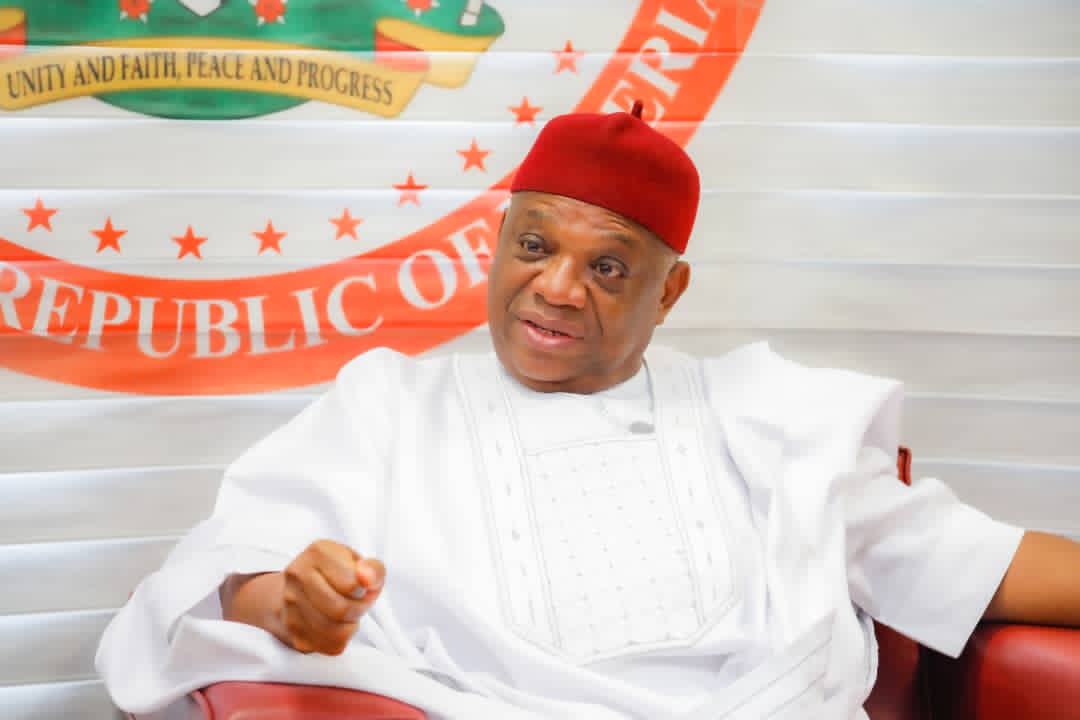
Senator Orji Uzor Kalu has reiterated support for President Bola Ahmed Tinubu’s economic reforms and called on Nigerians in the Diaspora to back the administration, even as he opposed calls for the return of petroleum subsidy.
The Senator representing Abia North Senatorial District made the remarks on Wednesday in Maryland, United States, where he also canvassed support for the election of Dr. Obafemi Hamzat, the incumbent Deputy Governor of Lagos State, as the state’s next governor.
Kalu was hosted by a cross-section of Nigerians and Lagos indigenes in the Diaspora. He fielded questions on the state of the Nigerian economy, the Tinubu administration’s reforms and the political direction of the country.
The two-term senator, who is also Chairman of the Senate Committee on the South East Development Commission, SEDC, and is seeking re-election on the platform of the All Progressives Congress, APC, described Hamzat as a competent choice for Lagos.
According to Kalu, Hamzat’s long experience in the Lagos State Government gives him a strong understanding of governance and Nigeria’s diverse population.
“Governor, the Deputy Governor of Lagos State, Dr. Obafemi Hamzat, is a good choice. Yes, in kind, in person, in mind, and in everything,” he said.
“He has been in the government of Lagos State from 2006 till today. He understands government, he understands our people, he understands Nigeria, he understands the Yorubas, he understands the Hausas and the Igbos.”
Kalu said Hamzat could be entrusted with the responsibility of building a new Lagos and contributing to a new Nigeria where citizens would have a greater sense of belonging.
“And I believe he will be a trustee of that dream to build a new Lagos, a new Nigeria, where everybody will have a say in the country.”
Turning to the Federal Government’s economic policies, Kalu said fundamental reforms could not deliver their full benefits overnight.
He said President Tinubu had taken difficult decisions aimed at stabilising the economy, drawing comparisons with reforms undertaken in countries such as Singapore.
“I will deviate a little bit to speak and talk about our President. It’s very difficult to do reforms. Today, you see people celebrating that he did a reform that is one of the best in Singapore. Yes, it’s true. But it took years!” Kalu said.
Kalu, who disclosed that he contested the presidency in 2007 before stepping down, said his political experience had given him an understanding of the difficulties involved in governing Nigeria.
“So, what President Tinubu is doing, I understand very well. Most people don’t understand. Most Nigerians don’t understand.”
He said the administration’s immediate objective was to stabilise the polity and create a more conducive environment for economic activity.
“First is to stabilise the polity, the entire polity, by bringing the price of foreign exchange to the playing table, and also bringing the price of fuel to the playing table, and bringing the environment to be conducive.”
However, Kalu acknowledged that while progress had been made at the macroeconomic level, Nigerians were still experiencing difficulties at the microeconomic level, particularly because of insecurity.
“But the micro area has not done very well because of insecurity… People can’t go to farm, people can’t go to work in some areas, local governments in Northern Nigeria, and also in some of our South East and all parts of Nigeria.”
Kalu faulted calls by some political leaders for the restoration of petroleum subsidy, arguing that the policy had historically created opportunities for corruption and financial abuse.
He said his position was informed by his political experience and exposure to the petroleum business.
“I was seeing some of our leaders saying they should bring back subsidy. I say it’s a laughing stock for anybody… I have two tank farms. I have a tank farm in Akwa Ibom, Cross River, and I have a palm farm in Lagos,” he said.
He declared that government should explore other measures to cushion economic hardship rather than return to fuel subsidy.
“And I believe that bringing back subsidy is not best for Nigerians. It’s not an option for the economic development of Nigeria. Government can do other things, not fuel subsidy.”
Kalu alleged that the former subsidy regime was riddled with fraudulent beneficiaries, claiming that a significant number of the companies involved were not genuine.
“We were about 143 companies that were doing subsidy, and I can tell you that half of the 143 were fake.”
He further linked the removal of subsidy to a reduction in what he described as conspicuous spending among beneficiaries of the former arrangement.
“And while it was running… I can tell you that, you can see the level of private jets have reduced in Nigeria,” he said, amid laughter, “because there’s no more subsidy.”
The Abia North senator praised Tinubu for taking what he described as a difficult but necessary decision.
“So, President Tinubu took a major decision that most people cannot take, and this is what Nigeria requires.”
While defending the administration’s reforms, Kalu said Tinubu still had significant work to do, particularly in restoring security and creating conditions for economic growth.
“But President Tinubu has a lot of work to be done in the next couple of months and years, which is to reform, to bring back the security dynamics to normal,” he said.
According to him, Nigeria had reached a stage where the focus should now shift from stabilisation to growth, with improved security enabling farmers and businesses to return to productive activities.
“This is why, and this is where, and this is when our macroeconomy and microeconomy are starting. We have reached where we are supposed to be. All we need is just to touch the growth area.”
He identified insecurity, rural economic activity and local government autonomy as critical areas requiring attention.
“What we need for growth is to fight insecurity, farmers will go back to farm, people will go back to work in the rural areas, local government will have autonomy, local government councils will start disbursing money, and society will become normal.
Kalu also appealed to Nigerians, particularly in the South East, to avoid what he described as the fragmentation of their political votes along ethnic lines. He urged support for the APC and political consolidation.
“So, I will also appeal to you people to support our party. To support us.”
He warned against dividing votes along ethnic lines, stressing that Nigeria’s challenges required cooperation.
“Because there’s no need of dividing our votes as Igbos, as Nigerians, as Hausas. Everybody in Igbo that will shoot today, divide our votes as the enemy of Nigeria.”
Kalu concluded with a call for greater unity, compassion and mutual assistance among Nigerians.
“This is the time for consolidation for the government of Nigeria, for the people of Nigeria. There’s a lot of hatred among us as Igbos, as Nigerians, as people of faith. We must love ourselves. We need love more than quarrelling.
“We need assistance more than fighting. We need hands to help each other. We need to be our brother’s keeper.”