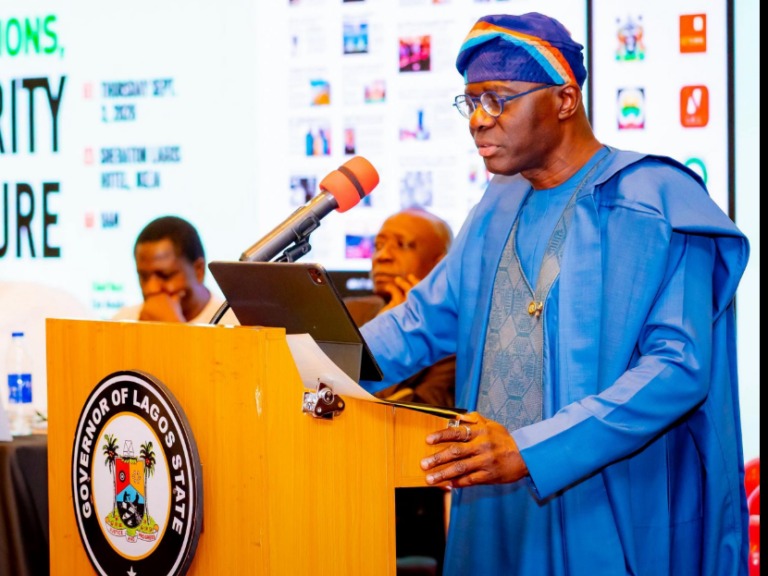
Lagos State Governor, Babajide Sanwo-Olu, has warned politicians against heating up the polity ahead of the 2027 general elections, stressing that no political office is worth the life of any Nigerian.
Sanwo-Olu spoke at the 7th annual lecture of Freedom Online, themed “2027: Elections, Economy, Security and Nigeria’s Future,” where he urged political actors to prioritise national stability and democratic development over the pursuit of power.
The governor said the 2027 campaign season had already begun to take shape, predicting that opposition politicians would increasingly make the removal of fuel subsidy a major campaign issue.
He, however, defended the Federal Government’s decision to end the subsidy, arguing that it had become a major drain on the nation’s resources.
According to him, the subsidy was not removed because the government wanted to inflict hardship on Nigerians, but because it had become unsustainable and was diverting funds that could have been used for critical infrastructure and social services.
“The subsidy was not removed because anybody enjoyed removing it. It was removed because it had become a hole in the national purse through which the money for roads, schools and hospitals was draining away,” he said.
Sanwo-Olu acknowledged that the policy had imposed hardship on Nigerians, saying Lagos residents had felt its impact through rising transport costs, food prices and other living expenses.
He, however, maintained that the emerging economic indicators suggested that the reforms were beginning to yield results.
He cited the National Bureau of Statistics’ reported second-quarter economic growth of 4.43 per cent, compared with 3.89 per cent in the first quarter, as well as improvements in foreign reserves, trade balance and inflation.
The governor also pointed to increased remittances from Nigerians abroad, saying the Central Bank of Nigeria reported $947 million in formal remittances in July, describing it as the highest monthly figure recorded.
“These are not my numbers. They belong to the National Bureau of Statistics and the Central Bank of Nigeria, and every journalist in this hall can check them,” he said.
Sanwo-Olu said the All Progressives Congress would remain committed to the reforms while ensuring that their benefits reached Nigerians who had borne the immediate costs.
On security, he said the issue would play a crucial role in the 2027 elections, both because insecurity could prevent campaigns and voting in affected communities and because voters’ perception of safety would influence their choices.
He urged the Independent National Electoral Commission and security agencies to begin preparations early to guarantee the safety of electoral personnel, materials, candidates and voters.
The governor also highlighted recent efforts by the Federal Government to strengthen the security architecture, including the expansion of the Nigerian Army from eight to 12 divisions, the establishment of a Special Operations Command by the Nigerian Navy, decentralisation of police training and the deployment of Forest Guards and Mining Marshals.
He said political competition must not be allowed to degenerate into violence, stressing that “no office is worth the life of any Nigerian.”
In his welcome address, the publisher of Freedom Online, Gabriel Akinadewo, said Nigeria appeared trapped in a four-year election cycle without a corresponding four-year development cycle.
Akinadewo noted that by May 29, 2027, the country would have attained 28 years of uninterrupted civilian rule, describing it as a major milestone.
He called for the modernisation of Nigeria’s laws and governance systems to reflect the realities and challenges of the 21st century.
The chairman of the occasion, Lai Mohammed, said the 2027 election should be seen beyond a contest for political power and viewed as a commitment to continued nation-building.
Mohammed said politics must not override governance, arguing that the true measure of democratic progress was the ability of elections to strengthen institutions, attract investment and guarantee peace.
He also stressed the link between security and economic development, saying businesses and investors could not thrive where safety was not guaranteed.
Similarly, former Ogun State Governor, Senator Gbenga Daniel, described security as an economic issue and an essential component of the nation’s economic infrastructure.
Daniel urged Nigeria to diversify its economy beyond oil, citing the country’s young population, entrepreneurial culture, technology sector, financial institutions and creative economy as key areas of opportunity.
He said the priority should be to transform these sectors into productive jobs, higher incomes and improved living standards, particularly for young Nigerians.
“They need more than speeches. They need skills, employment, access to capital, technology, and a society in which enterprise and hard work can lead to a better life,” Daniel said.