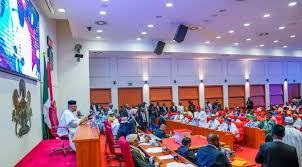
A bill to establish state police and transfer policing powers to subnational governments scaled second reading in the Senate on Thursday.
The bill, which received bipartisan support, was referred by the President of the Senate, Godswill Akpabio, to the Ad-hoc Committee on the Review of the 1999 Constitution for further legislative work.
Senate Leader, Opeyemi Bamidele, led the debate and said the move was necessary to strengthen internal security amid the overstretched capacity of the Nigeria Police Force.
Nigeria is grappling with terrorism, violent extremism, banditry, mass abductions, farmer-herder clashes, cultism, armed robbery, pipeline vandalism, communal conflicts, and cyber-enabled crimes.
Bamidele said Nigerians have demanded state police because the current centralized structure cannot adequately address localized and evolving security threats.
He sponsored the bill as part of measures to overhaul the country’s internal security architecture.
The proposed legislation seeks to create Federal and State Police structures with clearly defined responsibilities.
It also provides for State Police Service Commissions, oversight mechanisms, and the transfer of policing from the Exclusive Legislative List to the Concurrent Legislative List to deepen cooperative federalism.
Bamidele stressed that the amendment would not undermine national unity but would allow each tier of government to discharge its constitutional duties more effectively.
He acknowledged concerns over potential abuse by state governments but said the bill contains safeguards to address them.
The safeguards include State Police Service Commissions, federal oversight through the Federal Police Service Commission, uniform national standards, and legislative confirmation of senior appointments.
Other measures are constitutional procedures for removing state commissioners of police, periodic review of state police operations, and federal intervention in cases of total breakdown of law and order.
Bamidele said the framework balances operational autonomy with accountability and constitutional oversight.
He argued that security is most effective when localized, noting that officers familiar with a community’s terrain, language, and culture are better placed to detect crime early.
State police, he added, would improve intelligence gathering and strengthen Nigeria’s intelligence architecture, as modern policing relies more on intelligence than force.
Bamidele further said decentralized formations would ensure faster response to emergencies, unlike the current structure that often suffers bureaucratic delays.
After the lead debate, several senators, mainly from the North, backed the bill and described state police as a lasting solution to insecurity.
Senate Chief Whip Tahir Monguno said the bill would curb the proliferation of vigilante groups by providing a legal framework for state police with proper regulation and accountability.