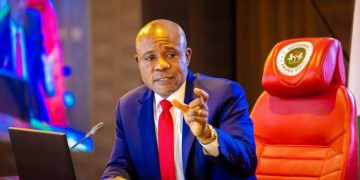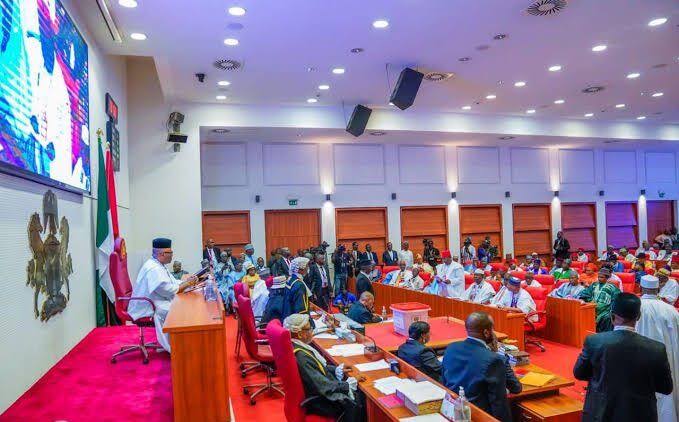
The Chairman, Senate Committee on Appropriations, Senator Solomon Adeola, on Monday, said that Nigeria would continue to borrow to fund the N25 91 budget deficit.
Adeola made this assertion at the National Assembly complex, Abuja, during a public hearing on the 2026 Appropriation Bill, which was attended by the Minister of State for Finance, the Accountant General of the Federation, economic aaexperts and senior government officials.
He also posited that the National Assembly would no longer approve budget rollovers, stressing that strict adherence to budget timelines, stronger legislative oversight and improved fiscal discipline would now guide budget implementation.
“Never again will the National Assembly approve budget extensions. We must discipline our budgeting cycle, enforce strict adherence to appropriation timelines and ensure better coordination between policy design and implementation,” Adeola said.
He noted that Nigeria’s development challenges, infrastructure deficit and revenue uncertainties indicate that the country could not avoid borrowing, stressing however, that government must adopt smarter and more sustainable deficit-financing strategies.
“Nigeria cannot help but keep borrowing because revenue inflows are unpredictable and development needs are enormous. What matters is how we borrow and how we fund our deficits,” he said.
Adeola said that Nigeria must continue to meet its obligations to protect its sovereign credit rating and international standing, noting that the government was deliberately avoiding excessive domestic borrowing that could crowd out private sector credit, opting instead for external financing, asset optimisation, privatisation, public-private partnerships, joint venture asset leveraging and Eurobond issuances.
“Government is deliberately avoiding excessive domestic borrowing that could crowd out private sector credit. Instead, we are exploring external financing, asset sales and privatisation to bridge revenue gaps,” he said.
The politician also insisted that electricity subsidy must be fully removed, arguing that complete liberalisation of the power sector would unlock massive resources for development, pointing out that trillions of naira previously spent on fuel subsidies had worsened fiscal pressure, and that subsidy removal was a necessary foundation for economic reforms.
“Trillions of naira were spent annually on fuel subsidies, money that did not exist. We borrowed to fund it. The President took the bold step of removing subsidies, and that decision laid the foundation for the reforms we see today,” Adeola said.
The lawmaker also urged the executive to aggressively deploy public-private partnerships, particularly in infrastructure development, to ease pressure on public finances. He said roads and other critical assets should be concessioned to generate steady revenue while reducing government spending.
Earlier, economist and fiscal policy expert, Dr Olatilewa Adebanjo, warned that Nigeria’s rising budget deficit could become unsustainable unless urgent measures were taken to strengthen revenue mobilisation and enforce fiscal responsibility, calling for a comprehensive review and stricter enforcement of the Fiscal Responsibility Act, describing it as a powerful but underutilised legal instrument.
Also speaking, the Chief Commissioner of the Public Complaints Commission cautioned that weak accountability and poor oversight had worsened fiscal stress, citing abandoned projects, inflated contracts, arbitrary cost variations and substandard execution by Ministries, Departments and Agencies.
In his presentation, the Accountant General of the Federation, Shamseldeen Olujimi, called for a shift from focusing on budget size to emphasising measurable impact, describing the budget as a moral document that reflects government priorities and commitment to citizens.
The Minister of State for Finance, Dr Doris Nkiruka Uzoka-Anite, who represented the Minister of Finance and Coordinating Minister of the Economy, Wale Edun, and the Minister of Budget and National Planning, Senator Atiku Bagudu, said the budget was designed to deepen ongoing reforms and ensure efficient deployment of limited resources.
While declaring the public hearing opened, the President of the Senate, Godswill Akpabio, represented by Deputy Senate President, Senator Barau Jibrin, said that budgets must translate into concrete outcomes rather than remain theoretical exercises.