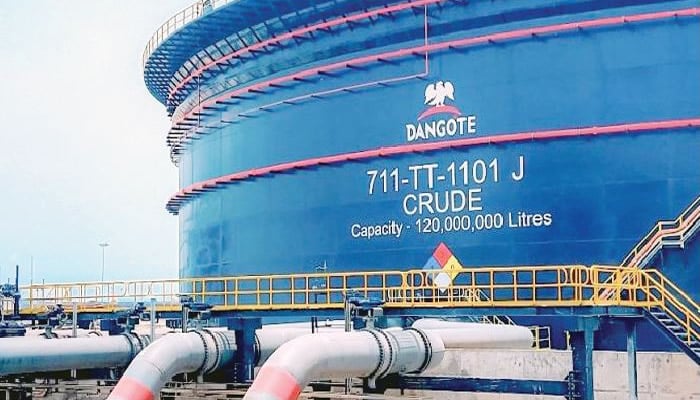
Nigeria’s economy has seen a remarkable reduction in fuel imports, thanks to Dangote Refinery, which has emerged as a major contributor to local energy production. According to Sunday Esan, Senior General Manager of Corporate Communications at Dangote Industries, the refinery now saves the country over ₦10 billion annually in foreign exchange, marking a significant economic milestone.
Beyond mere cost savings, the refinery has become a national landmark, driving job creation, stabilizing the Naira, and enhancing the country’s energy supply chain. Esan highlighted that nearly two years of operation have positioned Nigeria as a regional energy hub, attracting international interest, including inquiries from US buyers and Saudi Aramco for jet fuel and other refined products.
The refinery’s scale is staggering, sprawling across a territory seven times the size of Lagos’ Victoria Island and requiring approximately five hours to traverse by car. Its operations currently process 650,000 barrels of crude per day, with plans underway to nearly double capacity to 1.4 million barrels daily. This expansion promises to further reduce reliance on petroleum imports while boosting domestic energy security.
Investment in infrastructure has also generated employment on an impressive scale. The acquisition of 4,000 CNG trucks for distribution alone has created roughly 24,000 jobs. Esan emphasized that this demonstrates the economic impact a single visionary initiative, spearheaded by Alhaji Aliko Dangote, can have on national development.
Fuel import statistics underscore the refinery’s influence. In the first quarter of 2024, Nigeria spent $2.6 billion on imported petrol and diesel; by the same period in 2025, expenditure dropped to $1.2 billion. Such reductions not only preserve foreign reserves but also alleviate inflationary pressures, contributing to macroeconomic stability.
Media engagement is another critical component of sustaining Nigeria’s energy progress. Esan urged journalists, particularly members of the Nigeria Union of Journalists (NUJ), to ensure reporting on the sector is accurate and evidence-based. First-hand visits to the refinery, he noted, provide journalists with insights to counter misinformation and reinforce the facility’s national significance.
NUJ Lagos Chairman Adeleye Ajayi commended the lecture delivered during the ongoing Media Week, describing it as a vital opportunity for examining Nigeria’s energy landscape and acknowledging government and private sector efforts to harness local resources. He encouraged deeper collaboration between the media and industry stakeholders to maintain transparency and public trust.
Reflecting on past energy challenges, including periods of fuel scarcity and panic buying, the Press Week Committee Chairman Wale Akodu noted that improved local production has mitigated many previous crises. The Dangote Refinery stands as a testament to the positive impact of large-scale industrial investment on national resilience.