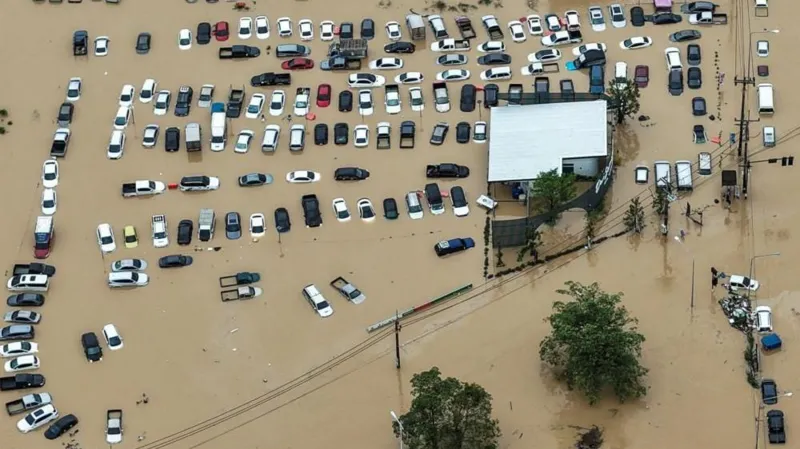
The city of Hat Yai in southern Thailand has experienced its heaviest rainfall in three centuries, leaving streets and homes submerged under more than 330mm of water in a single day. Many residents remain trapped on rooftops as floodwaters rise, waiting for rescue teams to reach them.
Authorities reported that over 2 million people across Thailand have been affected, yet only a fraction have been relocated to shelters. In some areas, stranded families have gone without food or clean water for days, relying on emergency broadcasts and social media pleas to call attention to their plight.
Across the region, the impact has been catastrophic. In Vietnam, flooding over the past week has claimed at least 98 lives, while northern Malaysia has seen more than 19,000 people displaced to evacuation centers in Kelantan and Perlis. Rescue workers there have waded through knee-deep waters to reach isolated communities cut off by rising rivers.
Indonesia has not been spared. In North Sumatra, landslides triggered by torrential rains have buried at least seven individuals, while 19 fatalities have been reported. Local search and rescue teams continue to comb affected areas, struggling against the challenges of unstable terrain and ongoing rainfall.
The Thai military has assumed a central role in relief operations, coordinating the deployment of an aircraft carrier, 14 supply boats, and field kitchens capable of serving thousands of meals daily. Medical personnel on board are prepared to convert the ship into a floating hospital if conditions demand.
Desperate social media posts illustrate the human toll of the floods. One viral clip shows three young boys clinging to power lines, inching over brown murky water to escape rising currents. Others have shared pleas for immediate evacuation, describing children, the elderly, and sick family members stranded above flood levels.
Government officials in Thailand’s Songkhla province have declared the region a disaster zone to expedite the release of emergency funds and support local rescue efforts. Nevertheless, widespread access issues and inundated roads continue to hinder relief, leaving many residents reliant on small boats, jet skis, and high-clearance trucks for evacuation.
Meteorologists attribute the extreme conditions to unusually heavy seasonal rains, which have intensified beyond historical averages this year. Experts warn that with water levels continuing to rise, the region faces the dual threat of disease outbreaks and structural collapse in vulnerable neighborhoods.
Despite the ongoing challenges, local and international relief organizations have mobilized to provide aid. Volunteers, military personnel, and civil defense units are coordinating distribution of supplies while attempting to map the most isolated areas, ensuring that the most at-risk populations receive assistance first.
Authorities continue to urge the public to stay vigilant, conserve energy and water, and report emergencies through official channels. The severity of this flood crisis underscores the urgent need for long-term infrastructure planning and regional cooperation to mitigate future disasters in Southeast Asia.