

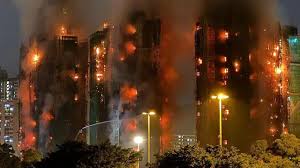
A massive fire ripped through the high-rise estate of Wang Fuk Court in Tai Po, Hong Kong, leaving a community reeling and raising serious questions about fire safety in the city’s older housing stock. What began as a quiet afternoon eruption quickly spiralled into one of the deadliest residential fires in recent years.
Local authorities confirm that at least 13 people have died, and dozens more have been injured including residents and at least one firefighter. Many others remain unaccounted for, with initial reports of people trapped inside buildings when the fire spread rapidly. Firefighters and rescue teams responded immediately, but thick smoke, intense heat, and collapsing scaffolding complicated efforts.
What Went Wrong Scaffolding, Renovations, and Rapid Spread
Wang Fuk Court is an older public-housing complex in Tai Po. The estate was undergoing renovation at the time of the blaze, and its buildings had been hushed in bamboo scaffolding and construction netting a common sight in Hong Kong’s urban renovation efforts.
Fire officials believe that the fire began on the external scaffolding and, aided by flammable materials and possibly wind, spread quickly from one block to several towers. The Klaxon was raised from a moderate alert to a No. 5 alarm the highest possible as the conflagration escalated.
Eyewitnesses describe chaotic scenes: thick black smoke pouring out of dozens of windows, flames flickering across multiple floors, and residents fleeing as alarms blared and fire trucks raced into action.
Aftermath: Lives Lost, Families Displaced, and Questions Raised
With fatalities confirmed including what appears to be at least one firefighter the toll of the disaster is already steep. Many injured victims were rushed to hospitals; several are in critical condition, while others remain in serious but stable condition.
Apartments in Wang Fuk Court housed hundreds of families. With nearly 2,000 units and an estimated 4,800 residents, the affected estate was densely populated. In the wake of the fire, many residents are now homeless, and authorities have opened temporary shelters for evacuees.
Beyond immediate losses, the disaster has reignited debate about building safety standards in Hong Kong. Bamboo scaffolding, though traditional and widely used has come under fresh scrutiny because of its high flammability. Several observers argue that the widespread use of such scaffolding during renovations increases the risk of large-scale fires, especially in older estates.
What This Means for Hong Kong Safety, Housing, and Collective Responsibility
The Wang Fuk Court fire is a tragic reminder of how vulnerable older urban estates can be especially when renovation, high population density, and lagging infrastructure converge. As emergency services continue search and rescue operations, families search for missing loved ones, and displaced residents face uncertain futures.
Authorities have signalled investigations into the cause of the blaze, and there may be calls for stricter building safety regulations, especially around renovation protocols and materials used in scaffolding. For residents of Hong Kong — and beyond the tragedy raises urgent questions: Are safety measures sufficient? Are older residential complexes being maintained properly? And, crucially, can vulnerable communities be protected against fire hazards in high-density housing?
For now, the city mourns. Emergency services, volunteers, and community members are working around the clock to aid the injured, evacuate those displaced, and ensure no one else is trapped. As the night deepens, hope remains that prompt rescue efforts and a renewed focus on safety will help prevent another catastrophe.


