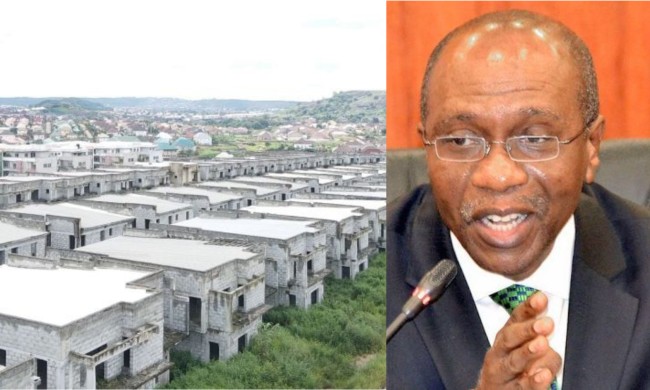
The Economic and Financial Crimes Commission (EFCC) has linked Godwin Emefiele, the former Governor of the Central Bank of Nigeria (CBN), to a sprawling estate in Abuja comprising 753 duplexes and other apartments.
Court documents revealed that the property, situated in the Cadastral Zone of Lokogoma District, spans 150,500 square meters and was allegedly acquired through corrupt practices.
In what it described as the largest single property recovery since its establishment in 2003, the EFCC announced the acquisition following a court ruling by Justice Jude Onwuegbuzie of the Federal Capital Territory (FCT) High Court, Apo, on December 2, 2024.
The anti-graft agency claimed that Emefiele, alongside his associates, used illicit funds to purchase the estate originally designated for mass housing development.
According to the EFCC, investigations revealed that Emefiele orchestrated fraudulent schemes during his tenure as CBN governor.
He allegedly received kickbacks from contractors awarded CBN projects and foreign exchange allocations. The funds were reportedly funneled through three companies, which paid N2.2 billion to acquire the property. Payments were broken down as N900 million, N700 million, and N600 million by the three entities.
The EFCC stated that the estate had been abandoned since June 2023, following Emefiele’s arrest. A search of the office of one of his associates, Ifeanyi Omeke, yielded documents tying Emefiele to the property. Investigators, assisted by the Abuja Geographical Information Systems, used these documents to locate and confirm ownership of the estate.
Court proceedings revealed that the EFCC had earlier obtained a temporary forfeiture order for the property on November 1, 2024. With no contest from any party, the court granted a permanent forfeiture to the Federal Government.
Emefiele, who is currently facing multiple legal battles, is being prosecuted by the EFCC on three fronts. Before Justice Hamza Mu’azu, he faces charges of procurement fraud, forgery, and other allegations. At the Special Offences Court in Lagos, Justice Rahman Oshodi is presiding over a case involving $4.5 billion and N2.8 billion in alleged fraud. Additionally, Justice Maryann Anenih is handling a case concerning N684.5 million in currency printing expenses.
In its affidavit, the EFCC asserted that the funds used to acquire the estate were not legitimate earnings but proceeds from corrupt practices, kickbacks, and abuse of office. Directors of the implicated companies have been arrested, and their statements obtained to support the EFCC’s claims.
Efforts to reach Emefiele’s legal team for a response were unsuccessful. One of his lawyers, Matthew Burkaa (SAN), did not answer calls or respond to text messages as of the time of filing this report.
Public criticisms have trailed the EFCC’s decision to initially withhold Emefiele’s identity in connection to the estate.
Addressing these concerns, EFCC spokesman Dele Oyewale explained that the proceedings were conducted under Section 17 of the Advance Fee Fraud Act, which allows action against properties rather than individuals in cases involving unclaimed assets. He added that revealing the names of individuals without direct links to property title documents would be premature and unprofessional.
Oyewale assured the public that the EFCC is committed to concluding its investigations, noting that the estate’s forfeiture represents significant progress in the agency’s anti-corruption efforts.