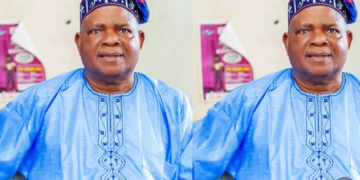
The Centre for Human and Socio-Economic Rights (CHSR), a Civil Society Organisation, has called upon Governor Babajide Sanwo-Olu to reopen all markets that are currently sealed by the state government.
Mr. Alex Omotehinse, the President of the group, made this appeal during a press conference held on Friday in Lagos, with the aim of alleviating the hardship faced by traders and residents in Lagos.
NAN (News Agency of Nigeria) reported that the Lagos State Government closed down four markets – Ladipo, Agbado Oke-Odo, Oyingbo, and Alayabiagba – in late September due to “serial infractions.”
The closure was disclosed by the state Commissioner for the Environment and Water Resources, Tokunbo Wahab, who cited environmental offenses such as reckless waste disposal, unhygienic premises, and non-payment of waste bills.
Omotehinse further urged Governor Sanwo-Olu to convene an inclusive stakeholders’ forum on street trading and market operations in Lagos State. He also stated that if necessary, the group would mobilize residents of the state to the State House of Assembly within the next 21 days to seek the resolution of their July 29, 2016 petition regarding the state’s environmental laws.
“The governor should reopen all markets currently sealed by the Lagos State Government to alleviate the anguish of traders and Lagos residents.
“Sanwo-Olu should deploy intelligence mechanisms for crime prevention by strengthening the police to arrest and prosecute offenders.
“The governor should deploy advocacy and sensitization mechanisms to address challenges, rather than banning and closing markets,” the CHSR boss said.
The activist urged Sanwo-Olu to consider measures that would empower the less privileged in the state, rather than actions capable of aggravating their hardship.
According to him, the state government should allow democratic management of markets by traders’ associations through elected representatives for effective service delivery.
Omotehinse said, “This is better than hand-picked lackeys, who have so far demonstrated incompetence in ensuring effective sanitation and waste handlings at the markets.”
He added that the government should put an end to the alleged extortion of traders and marketers by personnel of law enforcement agencies in the state.
The activist lamented that the ban on street trading by the government also coincided with the closure of some strategic markets.
“We consider our intervention appropriate in furtherance of our mandate to defend victims of abuse of human rights and to promote the cause of justice and peaceful coexistence in the society.
“The latest ban on street trading by the Lagos State Government raises more questions than answers.
“There is no alternative means of livelihoods being considered by the government to support the overwhelming majority of the masses, who engage in menial trading and hawking activities for survival.
“We are concerned about the implementation of the directive without the necessary engagement with stakeholders, either at the local government or community/grassroots level,” Omotehinse said.
He reiterated that street trading created ample access to goods by low-income consumers, who, he said, could not afford to shop in formal retail stores.
He emphasised that street trading was an essential source of income for many low-skilled workers, who were unable to secure formal employment.
“Research outcomes have attributed street trading to a number of factors, which include poverty, lack of education, immigration, unemployment, urban culture and low-income consumption.
“These factors also include lack of microfinance, lack of storage, theft or damage to goods,” he said.
The activist suggested that regulating street trading should be the way to go to preserve the livelihoods of the overwhelming population.
NAN recalls that the Lagos State Government had announced a total ban on street trading, hawking, building of illegal structures on drainages and display of wares on walkways across the state.