Former President Olusegun Obasanjo and Bayelsa State Governor, Douye Diri, have called for an upward review of the 13 per cent derivation fund allocated to oil-producing states, insisting that the Niger Delta deserves greater benefits from its natural resources.
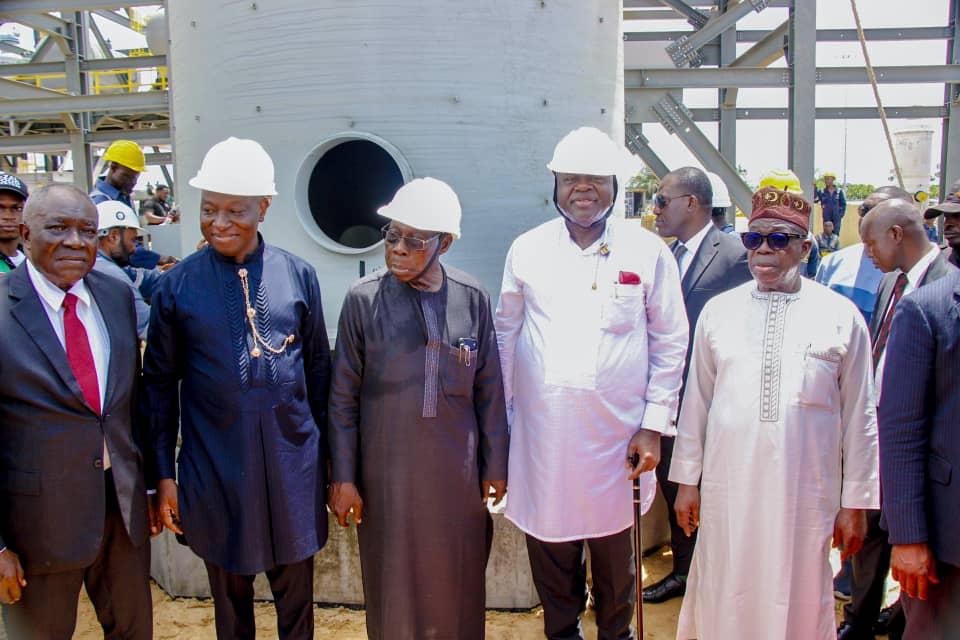
They spoke on Monday at the inauguration of the Crude Distillation Unit (CDU) of the $1 billion Azikel Refinery at Obunagha in Yenagoa Local Government Area of Bayelsa State.
Obasanjo described the existing 13 per cent derivation allocation as a starting point, urging oil-producing states and communities to sustain their demands for a higher share of revenue from crude oil production.
The refinery, owned by Azikel Petroleum, a subsidiary of Azikel Group, is projected to produce 2.5 million litres of petrol and two million litres of diesel daily, alongside other petroleum products.
Obasanjo commended the President of Azikel Group, Dr Azibapu Eruani, for driving the refinery project and challenged him to ensure its completion within the next 12 months.
The former president also acknowledged the contributions of the refinery’s technical and engineering teams, the African Finance Corporation (AFC) and the African Export-Import Bank (Afreximbank), urging them to sustain their support for the project.
He praised Diri for supporting the refinery, noting that Eruani had consistently acknowledged the governor’s contribution to its development.
Obasanjo further commended the Bayelsa government for what he described as the judicious utilisation of the state’s resources, citing the numerous development projects across the state.
“I have told Dr Eruani that I will be officially 90 years by next March. It means I will take the boarding pass soon. So, he has to make sure the project is completed before I exit,” he said.
Addressing the governor, he added: “You are right that the states and oil-producing communities have not got a fair deal so far. Thirteen per cent is the beginning. You can continue to talk. The most important thing is that even the little you have received, you have used it well.”
Obasanjo recalled that when he visited the project site eight years ago, there was little to show for the proposed refinery, expressing satisfaction with the progress recorded.
He urged the financiers and technical partners to continue supporting the project, adding that its completion could create opportunities for further expansion.
Speaking at the event, Eruani said the refinery would mark the beginning of industrialisation in Bayelsa State and the wider Niger Delta region.
He recalled that Obasanjo laid the foundation for the project eight years ago and expressed delight that the former president had returned for the installation of the CDU, which he described as a significant step towards completing the refinery.
According to him, the project was conceived to position the Niger Delta as an active participant in the oil and gas industry, describing it as the second-largest full-scale refinery in Nigeria.
Eruani commended President Bola Tinubu for supporting indigenous refinery projects, saying they aligned with the Federal Government’s efforts to improve the availability and affordability of petroleum products.
He also appreciated Diri, AFC and Afreximbank for their contributions to the project.
In his remarks, Diri said the refinery represented a significant victory for the Niger Delta after years of agitation over perceived injustice in the oil industry.
The governor maintained that communities producing crude oil should have a greater role in the industry and enjoy more benefits from the resources extracted from their land.
He criticised the Land Use Act and the current 13 per cent derivation arrangement, arguing that the region deserved a more equitable share of the wealth generated from its natural resources.
“As people of the Ijaw ethnic nationality, we have protested and fought because we feel that God gave us something in our land but we are not benefiting from it. Others are benefiting and saw us as second-class citizens,” Diri said.
He described the Land Use Act as unfair, arguing that the division of ownership between surface resources and resources beneath the ground disadvantaged the states and communities where oil was produced.
“We do not want to take all to ourselves. We just want to be co-players in determining how it is done. Thirteen per cent is not enough for the states,” he added.
Diri expressed optimism that the refinery would enable Bayelsans to become more active participants in the petroleum industry, urging residents, particularly young people, to acquire the skills required to benefit from the opportunities the project would create.
He also stressed the need for African countries to process their natural resources locally rather than export them in raw form, describing domestic processing as essential to unlocking the continent’s economic potential.
The governor called on oil companies operating in the Gbarain/Obunagha area to complement the state government’s efforts by rehabilitating the road leading to the refinery.
In separate remarks, a board member of Azikel Petroleum, Dr Daru Owei, and the Ibenanaowei of Ekpetiama Kingdom and Chairman of the Bayelsa State Council of Traditional Rulers, King Bubaraye Dakolo, commended Eruani for the project.
They expressed confidence that the refinery would improve the economic fortunes of Bayelsa State, the Niger Delta and Nigeria as a whole.