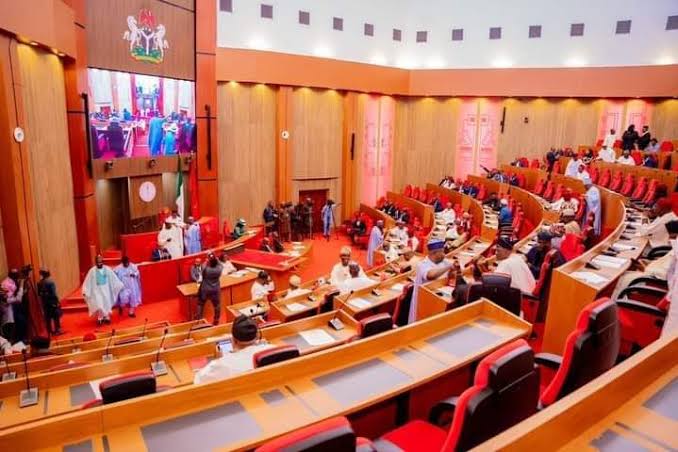
The Senate has expanded the mandate of its Ad-hoc Committee investigating the Safe Schools Initiative and granted it a three-week extension to conclude its assignment.
The Committee will now also probe the Tertiary Education Trust Fund, TETFund, Nigerian Education Loan Fund, NELFUND, Universal Basic Education Commission, UBEC, Federal Ministry of Humanitarian Affairs and Poverty Alleviation, and the National Social Investment Programme Agency, NSIPA.
The resolution followed a motion moved by the Committee Chairman, Senator Orji Uzor Kalu, APC, Abia North, pursuant to Orders 41 and 51 of the Senate Standing Orders, 2026.
Presenting the motion, Kalu said preliminary findings showed significant links between the implementation and funding of the Safe Schools Initiative and several federal institutions handling education funding, student welfare and social intervention programmes.
“Investigating the Safe Schools Initiative without reviewing these complementary bodies will result in fragmented legislative oversight,” he said. “The issues surrounding student security, educational infrastructure funding and social intervention schemes for vulnerable learners are deeply interwoven.”
He argued that expanding the mandate was necessary to deliver a comprehensive report that will strengthen accountability and ensure transparency in the management of intervention funds.
Under the new terms, the committee will evaluate financial flows, operational bottlenecks and accountability structures across the Safe Schools Initiative and the affected agencies.
It will also review social safety net allocations tied to school feeding, emergency relief for displaced students, and educational rehabilitation projects under the Humanitarian Ministry and NSIPA.
The panel is further expected to audit TETFund’s infrastructure and security intervention projects in tertiary institutions, assess NELFUND’s disbursement processes and student access, and examine UBEC’s interventions in basic education.
Kalu told the Senate that time constraints and other legislative engagements had affected planned oversight visits to critical locations.
“We’re supposed to submit our report, and there are four key areas that were not done. I needed the permission of the Senate so that we can conclude it in the next two or three weeks and come back with a report,” he said.
The President of the Senate, Senator Godswill Akpabio put the request to a voice vote and it was overwhelmingly approved.
The Senate inaugurated the Safe Schools probe in December 2024 following renewed attacks on schools. The abduction of 25 female students of Government Girls Comprehensive Secondary School, Maga, Kebbi State, during which bandits killed the Vice Principal, heightened concerns over student safety.
The Safe Schools Initiative was launched in May 2014 after the abduction of 276 schoolgirls from Chibok, Borno State. It was designed as a partnership between the Federal Government, the United Nations and private sector stakeholders to strengthen security around schools in conflict-prone areas.
During hearings, the committee raised questions over the disbursement of ₦15 billion released in 2023 for the programme. The Nigerian Police Force got the largest share of ₦6.225 billion, followed by ₦3.362 billion to NSCDC, ₦2.250 billion to Defence Headquarters and ₦519 million to the Federal Ministry of Education. The amount released to DSS was not disclosed.
The Committee also queried alleged financial irregularities and consultancy spending, and directed the Safe Schools Financing Office to provide a reconciled breakdown of all funds released, expenditures, names of contractors and documents relating to the CBN Trust Fund account.
National Coordinator of Financing Safe Schools in Nigeria, Hajia Halima Iliya, had told the committee that the initiative received $10 million from the Federal Government, $10 million from Nigerian business leaders, $1 million from AfDB, €2 million from Germany, $4 million from Norway through UNICEF, and additional support from USAID, Qatar Foundation and UN agencies.
With the expanded mandate, the Senate panel is expected to assess how education and humanitarian intervention funds are being deployed and determine if current programmes are effectively addressing the safety and welfare of Nigerian students.