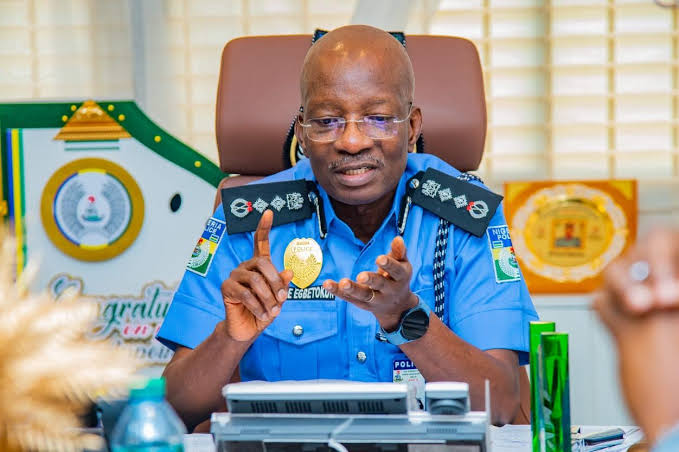
The Presidency on Monday confirmed that the resignation of Kayode Egbetokun as Inspector-General of Police was voluntary, dismissing claims that he was removed from office.
In a response to an inquiry, the Special Adviser to the President on Information and Strategy, Bayo Onanuga, stated that the former police boss stepped down due to personal circumstances.
“The IGP resigned in a letter today, citing family issues which require his undivided attention,” Onanuga said.
However, multiple Presidency sources disclosed that Egbetokun’s resignation followed a meeting with President Bola Tinubu at the Presidential Villa, Abuja, on Monday evening.
According to a senior official who spoke on condition of anonymity due to the sensitivity of the matter, the IGP was asked to step aside during the meeting.
“It was in that meeting he was asked to go,” the official revealed.
Egbetokun’s official vehicle, a Toyota Land Cruiser with registration number NPF-01, was sighted at the forecourt of the Presidential Villa around 6:40 pm on Monday. Dressed in his black uniform without his cap, he was seen alighting from the vehicle and retrieving his notepad from an aide before proceeding inside.
His arrival coincided with that of several state governors who were attending an interfaith Iftar (breaking of fast) with the President, initially creating uncertainty about the purpose of his visit. However, another source at the Villa clarified that Egbetokun had been specifically summoned by the President.
“He was called in. It wasn’t a routine visit,” the source said.
Security officials also disclosed that the former IGP returned to the State House at about 8:00 pm, with his vehicle reportedly searched by operatives of the Department of State Services at the Villa.
Egbetokun was appointed Inspector-General of Police on June 19, 2023. Prior to his appointment, he served as Deputy Inspector-General of Police in charge of the Force Criminal Investigations Department. He succeeded Usman Alkali Baba, whose tenure expired in September 2023 following an extension granted by former President Muhammadu Buhari.
His tenure was marked by growing concerns over Nigeria’s security challenges, including widespread kidnappings, banditry and terrorist attacks across several states. Notable incidents in recent months included the abduction of nearly 300 schoolchildren from St. Mary’s boarding school in Niger State in November 2025, mass killings in communities in Kwara State in February 2026, and persistent kidnappings along major highways.
During Monday’s Iftar with governors, President Tinubu reiterated his administration’s commitment to tackling insecurity, pledging that the establishment of state police would not be delayed.
“Security is the foundation of prosperity. Without it, farms cannot flourish, businesses cannot grow, and families cannot sleep in peace. We will establish state police to curb insecurity,” the President said.