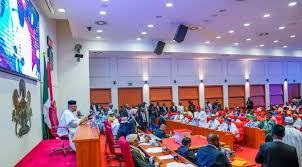
The Senate, on Tuesday, during plenary at the National Assembly Complex, Abuja, reworked and passed the Electoral Act, 2022 (Repeal and Enactment) Bill, 2026.
The Senate reworked and approved the bill following a motion by its Majority Leader, Senator Opeyemi Bamidele, requesting the Chamber to rescind the action it earlier took last week on the bill.
Approving the bill, the Senate readjusted the 360 days notice requirement prescribed in clause 28 to ensure that the 2027 Presidential and National Assembly elections do not fall within the period of Ramadan.
Also, for the second time in one week, the Red Chamber rejected ‘real-time‘ electronic transmission of election results, thereby favouring the manual mode where network fails.
The Leader of the Senate, Bamidele, coming under Order 1(b) and 52(6), moved the motion to rescind and re-commit the Electoral Act 2022( Repeal and Enactment ) bill 2026 to the Committee of the Whole, asking the Senate to completely jettison everything it had previously done on the Electoral Act Amendment Bill 2026.
He explained that the review had become necessary after the leadership of the Independent National Electoral Commission, INEC met with both Chambers of the National Assembly on ways to resolve conflict in the timing of the election and the Muslim festival of Ramadan.
It is pertinent to note that the INEC had last Friday, announced that the 2027 Presidential and National Assembly elections would hold on February 20, with governorship and state Houses of Assembly polls scheduled for March 6, 2027.
The electoral umpire rolled out the timetable amid ongoing debate on the Electoral Act Amendment bill, to allow for electronic transmission of election results in real-time.
It also came amid reactions from members of the Muslim community, who vehemently kicked against INEC’s proposed election dates, which coincided with their period of Ramadan.
After Bamidele moved the motion , the Chairman of Senate Committee on Electoral Matters, Simon Lalong, seconded it and explained that INEC Chairman, Joash Amupitan did not deliberately fix the election dates to conflict with the Ramadan as being speculated by some persons.
Lalong also told his colleagues that it was the immediate past INEC Chairman, Mahmood Yakubu that actually set the template for the election dates from 2019 to 2031.
Arguing why the adjustment in the election dates became necessary, the Senate said thst it had taken notice that the coincidence with the Muslim festival of Ramadan “could adversely affect voters turnout, INEC’s preparation and the overall credibility of the electoral process.
The apex Assembly also disclosed that it observed some discrepancies in the Long Title and 22 separate clauses -including the controversial clause 60 that deals with transmission of election results electronically from each polling unit to INEC IREV portal in real-time.
The Senate had last week passed electronic transmission of election results from polling units but rejected the phrase “real-time “when it included a caveat that where network fails, then the duly signed Form EC8A by the Presiding Officer and counter-signed by party agents (where available) shall be the primary source of election results ).
When it was time for the clause by clause consideration of the bill, the Senate passed clauses 1 to 59- including clause 28 on the 360 days notice of election requirements with relative ease, reducing the period from 360 to 300 days.
However, trouble started when lawmakers reached the contentious clause 60 with Senator Enyinnaya Abaribe raising a Point of Order, a development that compelled the lawmakers to go into a closed session that lasted almost an hour.
When the Chamber returned to open session, the arguments continued on Section 60, with Abaribe calling for division on the proviso in clause 60(3) that permits manual transmission of election results where network fails.
Accordingly, the President of the Senate, Godswill Akpabio, who said that the beauty of democracy is in full action, moderated the votes, asking Senators to signify which side of the divide they supported by standing up and raising up their hands in support of the proviso or against it.
At the end of voting, 55 Senators including the Deputy Minority Leader, Oyewunmi Olalere voted to retain the proviso to allow manual transmission where network fails, while Abaribe and 14 others mainly from the opposition, supported mandatory electronic transmission of election results in “real- time”.
In his remarks, Akpabio said that those who voted for the proviso for manual transmission had just saved Nigeria’s democracy, while commending Abaribe and his supporters for standing on their conviction.