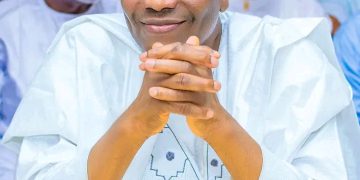
Vice President Kashim Shettima has said the opening of Nigeria House in Davos reflected the country’s renewed seriousness, readiness, and resolve to take its place as an active participant in shaping global economic conversations.
He observed that while nations do not prosper in isolation, Nigeria’s future growth depended on deliberate, structured engagement with the global economy.
According to a release by his spokesman, Stanley Nkwocha, Shettima stated this on Monday during the formal opening of the Nigeria House at the 2026 World Economic Forum (WEF) in Davos, Switzerland.
He said Nigeria marked a historic milestone in its global economic engagement with the official opening of its House at the WEF 2026.
“This day is extraordinary in the history of our engagements at this beautiful meeting point of global political leadership, policy thinkers, and corporate enterprise. For the first time in our nation’s history, Nigeria stands at Davos with a sovereign pavilion of its own.
“Nigeria House is a response to the lapses of the past. It reflects our intention. It reflects our seriousness. Above all, it advertises both our readiness and our resolve to take a front-line seat in the discourse of the global economy, not as observers, but as participants with a clear sense of purpose and place,” he stated.
The Vice President pointed out that even though “Nigeria House may have been conceived as a whole-of-government platform, led by the Honourable Minister of Industry, Trade and Investment, with senior leadership across investment, foreign affairs, energy, infrastructure, technology, climate, and culture gathered under one roof,” the true essence of the House must come from the private sector.
“Government can open doors, create frameworks, and de-risk environments; only enterprise can animate growth, scale opportunity, and translate policy into productivity.
“This House will thrive to the extent that it draws life from private capital, private innovation, and private confidence,” he maintained.
Shettima explained that the dividends of the Tinubu administration’s reforms were beginning to materialize, noting that “our decision to open up to the world more deliberately comes at a turning point in our economic journey.
“The dividends of the difficult but inevitable reforms of recent years are beginning to show,” he added, recalling that in 2025, Nigeria’s economy expanded by about 3.9 per cent, the fastest pace recorded in over a decade, driven largely by a resilient non-oil economy that now accounts for roughly 96 per cent of GDP.
He continued: “Services, agriculture, finance, and technology are expanding, while non-oil revenues now make up nearly three-quarters of government collections, marking a structural shift away from oil dependence.
“Inflation, which stood above 30 per cent in late 2024, eased significantly by the end of 2025, and external buffers have improved, with foreign reserves rising above 45 billion dollars and greater stability in the foreign exchange market.”
He invited the international business community to leverage the platform created through the Nigeria House project, noting that “Nigeria is open for business, but more importantly, Nigeria is open for collaboration.”
Shettima assured that the Nigeria House would host conversations that must have to move the nation and the global community forward.
“We are here to learn from you just as much as we are here to inform you of the opportunities that await in Nigeria. Progress is not a monologue; it is a dialogue,” he further stated.
Earlier, Minister of Industry, Trade and Investment, Dr Jumoke Oduwole, applauded the support of Vice President Shettima for the realisation of the historical vision for Nigeria House, Davos.