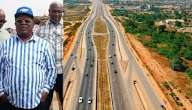
Nigeria’s Minister of Works, Senator David Umahi, has defended the Lagos–Calabar Coastal Highway as one of the most transparent and closely monitored infrastructure projects in recent national history, emphasising that the federal government is inviting anti-graft agencies to scrutinise every cost and detail of the work. Umahi spoke during the temporary opening of the first section of the highway in Lagos, where he underlined that the project is being carried out with detailed supervision, full documentation, and complete openness to audit by both the Independent Corrupt Practices and Other Related Offences Commission (ICPC) and the Economic and Financial Crimes Commission (EFCC). The minister stressed that the highway initiative has nothing to hide, noting that all drawings, bills of quantities, and cost breakdown records are available for verification by anyone seeking clarity on expenditure and process.
The minister described the coastal highway as a key legacy infrastructure programme under President Bola Ahmed Tinubu’s Renewed Hope Agenda, and highlighted that Section 1 — from Ahmadu Bello Way to Eleko Village — has been constructed with reinforced concrete pavement, street lighting, CCTV systems, and emergency response points intended to ensure durability and safety for road users. Umahi said the federal government has voluntarily opened all project documentation to anti-corruption agencies and invited them to audit and report on all costs associated with the scheme. He challenged critics to present specific concerns about project finances, pledging to provide cost information for individual components whenever requested.
Umahi also revealed that a significant portion of Section 1 has been funded and that contractors remain fully mobilised to continue the work. He appealed for sustained cooperation from contractors and urged motorists to exercise caution on the newly opened temporary stretch. The minister provided an update on Section 2 of the highway, reporting that substantial progress had been made in earth filling and concrete laying, with a targeted completion date of December 2026. He also noted that engineering challenges such as swampy terrain are being addressed to keep the project on track.
Umahi’s detailed defence of the coastal highway comes amid broader public debate about cost, transparency, and accountability in major federal infrastructure projects. While critics have previously raised questions about expenditure and project disclosures, the works minister’s invitation to the ICPC and EFCC to conduct comprehensive audits is intended to reinforce confidence that the government’s actions are above board. He also used the platform to criticise behaviours that undermine traffic flow on federal highways, urging state authorities and security agencies to enforce laws against illegal hawking and unauthorised truck parking that impede road use.
The Lagos–Calabar Coastal Highway is designed to span several coastal states and is being constructed in phases, with the first segment now operational on a temporary basis. Umahi reiterated that the project’s implementation reflects meticulous planning and that transparency and accountability are central to the process. By inviting anti-corruption agencies to review every cost detail, the minister signalled a determination to counter narratives of opacity and bolster public trust in one of the most ambitious road projects in Nigeria’s history.