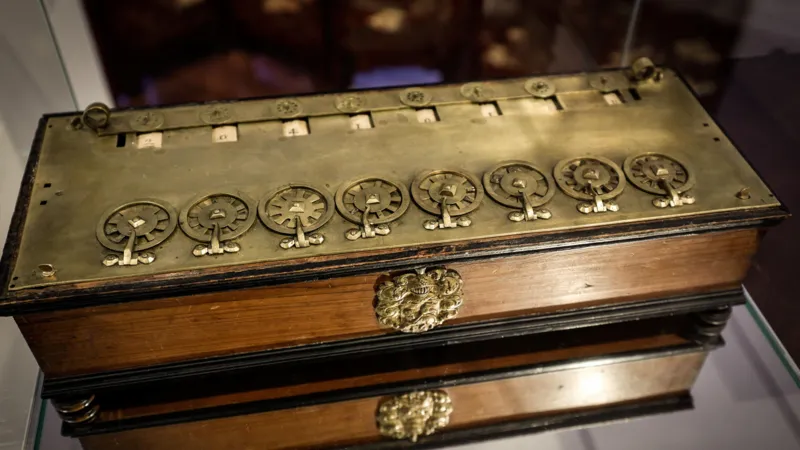
In a significant decision for the preservation of scientific heritage, a Paris administrative court has temporarily blocked the planned auction of one of the world’s earliest mechanical calculators, La Pascaline, originally developed by French mathematician Blaise Pascal in 1642. The court’s ruling prevents the historic device from being exported from France, pending a final judgment, citing its potential classification as a “national treasure.”
The auction, managed by Christie’s, had valued La Pascaline at between €2 million and €3 million (£1.7–2.6 million), with Christie’s calling it “the most important scientific instrument ever offered at auction.” The machine represents the first known attempt to automate calculation, a revolutionary step that substituted human computation with mechanical processes. Today, only nine of these calculators remain in existence worldwide.
Legal action to block the sale was initiated by scientists and researchers who argued that the machine’s historical and scientific significance warrants protection under French heritage laws. The Paris court noted “serious doubts” regarding the legality of an earlier export authorization issued by France’s culture minister in May, which had been approved by two experts, including a representative from the Louvre Museum.
Christie’s confirmed that it will suspend the sale of La Pascaline in line with the court’s provisional decision. “Given the provisional nature of this decision and in accordance with the instructions of its client, Christie’s is suspending the sale of La Pascaline,” a spokesperson said.
The calculator has been part of Christie’s exhibitions in New York and Hong Kong throughout the year and was slated for auction alongside other historic items from the library of the late Catalonian collector Léon Parcé. This collection included Pascal’s philosophical work Pensées and the first printed version of his famed “Pascal’s wager.”
Experts emphasize that La Pascaline is not only a remarkable artifact for its mechanical ingenuity but also a milestone in the history of mathematics and computing. Pascal was only 19 years old when he designed the device, which used a series of interlocking gears and wheels to perform basic arithmetic operations. The invention marked a pivotal moment in the evolution of computational technology, a legacy that continues to influence modern computing devices.
The court’s decision underscores the importance of safeguarding cultural and scientific heritage against private acquisition and international transfer. French heritage authorities and advocacy groups, including Association Sites & Monuments, have welcomed the ruling, highlighting the need to ensure that historically significant artifacts remain accessible for study and public engagement.
#LaPascaline #BlaisePascal #ScientificHeritage #MechanicalCalculator #France #ParisCourt #ChristiesAuction #HistoricalArtifacts #NationalTreasure #InnovationHistory #Mathematics #HeritageProtection