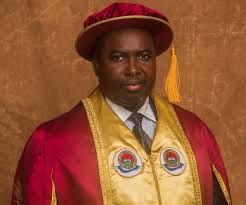
A 2020 report has resurfaced linking Nigeria’s newly appointed Chairman of the Independent National Electoral Commission (INEC), Prof. Joash Ojo Amupitan (SAN), to a strongly worded legal brief accusing both government officials and armed groups of committing genocide and crimes against humanity in Nigeria.
According to the document, obtained by SaharaReporters, Prof. Amupitan — who now leads Nigeria’s electoral body — concluded that “there is evidence that genocide, war crimes and crimes against humanity have been committed by both State and non-State actors.”
The legal brief, titled “Genocide in Nigeria – The Implications for the International Community,” was part of a 2020 international report published by the International Committee on Nigeria (ICON), a global human rights advocacy group. The paper was officially signed under Amupitan’s law firm, Prof. Joash Ojo Amupitan (SAN) & Co., with offices in Jos and Abuja.
In the report, Amupitan accused “state actors” of being complicit in the mass killings and religiously motivated attacks that had taken place across Nigeria during the administration of former President Muhammadu Buhari, who is now deceased. He described the situation as a “silent slaughter” and warned that Nigeria was edging toward a humanitarian catastrophe comparable to Rwanda, Darfur, and Myanmar.
“The Nigerian Government has not demonstrated sufficient willpower to deal with the crises; hence they have persisted and proliferated,” Amupitan wrote. “Lives are being lost daily, thereby inching the country’s destination to another Holocaust.”
The INEC chairman, in his recommendations, urged the United States and the United Nations to take immediate steps to stop what he described as a “pogrom” against Christians and minority groups. He specifically called on the U.S. Department of State to refer Nigeria’s situation to the U.S. Department of Justice and the U.N. Security Council for possible international action.
Among his proposals, Prof. Amupitan suggested the establishment of “an independent, neutral and impartial international commission of inquiry” to investigate the causes of mass killings, identify perpetrators, and recommend urgent solutions.
He further called for sanctions on both Nigerian government officials and militant groups implicated in the atrocities. According to the brief, such measures should be enforced under Articles 41 and 42 of the U.N. Charter, which allow for diplomatic and even military intervention in severe cases of human rights abuse.
Amupitan also proposed that the U.N. Security Council refer Nigeria to the International Criminal Court (ICC) under Article 13 of the Rome Statute, and that contracting states under the Genocide Convention sue Nigeria before the International Court of Justice (ICJ) for failing to prevent and punish genocide.
“Contracting Parties to the Genocide Convention should sue Nigeria at the International Court of Justice for failing to comply with its obligations,” he wrote.
In his brief, Amupitan lamented the lack of accountability for both terrorist groups and government security forces, stating that the “crises caused by Boko Haram, ethnic militias, and the excesses of the security agencies have occasioned protracted, needless killings.”
He accused authorities of treating the Fulani herdsmen differently from Boko Haram despite the scale of their attacks, writing that while Boko Haram was designated a terrorist organisation in 2013, the Fulani herdsmen had merely been “labelled” as such without official recognition or prosecution.
Prof. Amupitan warned that Nigeria risked repeating the tragic mistakes of Rwanda and Sudan, where the international community failed to act until it was too late. He added that without international pressure, “Nigeria’s leadership would continue to act with impunity, enabling extremist groups to operate unchecked while silencing victims through intimidation and state-sponsored violence.”
In one of the report’s most striking conclusions, Amupitan stated that “military action by the U.N., African Union or ECOWAS forces may be taken as a last resort” if Nigeria failed to protect its citizens.
The reemergence of this report has generated discussion across political and civil society circles, given Amupitan’s new role as INEC Chairman — a position expected to uphold neutrality and public confidence in Nigeria’s democratic process.
Report Reveals INEC Chairman Amupitan Once Called for U.S., U.N. Action Against Nigeria Over Genocide Allegations