
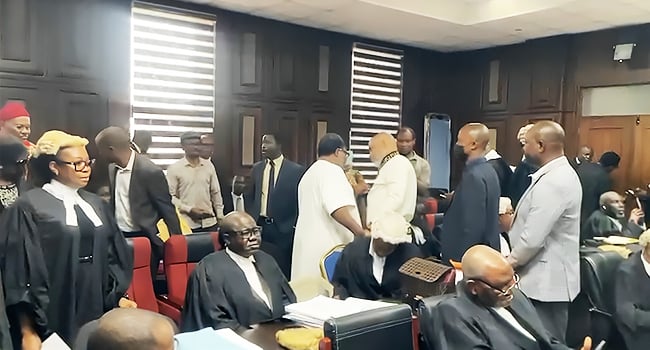
The detained leader of the Indigenous People of Biafra (IPOB), Nnamdi Kanu, has taken over his own legal defence after his lead counsel, Chief Kanu Agabi, SAN, and other members of his legal team withdrew from his ongoing trial at the Federal High Court in Abuja.
Chief Agabi, a former Attorney General of the Federation and Minister of Justice, announced his withdrawal during Thursday’s court session, informing the presiding judge, Justice James Omotosho, that Kanu had decided to represent himself and had taken possession of his case file.
Confirming the development from the dock, Kanu told the court that he would henceforth handle his defence personally.
He also declined Justice Omotosho’s offer to have a lawyer appointed for him, insisting that he was prepared to conduct his case without legal representation.
In his first act as his own counsel, Kanu challenged the jurisdiction of the court to try him on the seven-count terrorism-related charge filed by the Federal Government. The IPOB leader, who has been in detention since 2021, maintained that he was capable of defending himself and that his forthcoming witnesses would establish his innocence.
In a motion he personally signed and filed before the court, dated October 21, 2025, Kanu listed 23 prominent Nigerians he intends to call as witnesses. The list includes serving governors, ministers, and former security chiefs whom he described as “vital and compellable witnesses.”
Among those mentioned are Governor Hope Uzodimma of Imo State, Governor Babajide Sanwo-Olu of Lagos State, Minister of the Federal Capital Territory (FCT), Nyesom Wike, and the former Attorney General of the Federation, Abubakar Malami (SAN).
Others include the former Chief of Army Staff, Lt. Gen. Tukur Buratai (rtd); Minister of Works, Dave Umahi; former Governor of Abia State, Okezie Ikpeazu; Gen. Theophilus Danjuma (rtd); former DG of the National Intelligence Agency, Ahmed Rufai Abubakar; and former DG of the Department of State Services, Yusuf Bichi.
Kanu requested the court to grant him 90 days to enable him to present and conclude his defence, arguing that the earlier six days allocated by the court were insufficient given the number and status of the witnesses.
He also sought the issuance of subpoenas to compel their attendance, insisting that their testimonies were essential to proving his innocence.
The court has not yet ruled on Kanu’s application or on how his decision to discharge his legal team will affect the pace of the ongoing trial.