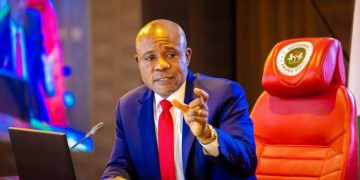
Connected Advocacy held a capacity building workshop at Sabongari, Kaduna Local government on carbon emission reduction strategies.
The Executive Director, Connected Advocacy, Prince Israel Orekha, disclosed this to newsmen on Friday in Lagos.
Orekha said that the goal of the workshop is to localize the country’s net zero commitment by devising achievable decarbonization plans that are implementable locally.
In his Welcome Address,Hon. Dr. Engr. Ibrahim Mohammed Chairman Sabongari LGA encouraged and appreciated the organizers, particularly Connected Advocacy, for their commitment towards climate education
Chairman’s was ably represented by Hon. Umar Shehu, who underscored the significance of the issue which resonated in his speech on emission and how a depleted ozone layer could lead to serious consequences for the sustainability of live on earth.
“Our LGA is committed to playing its part in achieving Nigeria’s Net-Zero goal.
“This climate action plan will provide us with a roadmap for reducing emissions and building a more sustainable future for our community,” Sheu said.
Orekha gave a robust presentation on climate change and why it’s particularly a threatening issue for Sabon Garri.
He identified the causes, effects and unique consequences of climate change Nigeria’s net-zero commitment and local government action.
The executive director elaborated on Nigeria’s net-zero pledge, explaining climate action plans and policies.
He emphasized the crucial role of LGAs due to their proximity to communities and firsthand understanding of local challenges.
Key points highlighted included community engagement for effective solutions the importance of data-driven decision making policy implementation and advocacy for achieving Net-Zero emissions.
Effective climate action planning principles integrating mitigation strategies (reducing emissions) and adaptation strategies (adjusting to climate change impacts).
The executive director said that the highlighted elements crucial steps in accelerating sub-national government implementation and achieving Nigeria’s net-zero commitment.
Orekha also emphasized the role of rigorous data driven analysis and collaboration to scale up the process.
He said that energy poverty was a pressing challenge in the northern part of the country.
He added that people at the grassroots must deploy renewable energy to not only penetrate rural communities without access to the national grid, but to also contribute to global carbon mitigation effort.
Participants at the workshop identified key challenges such as plastic bag use, firewood burning, and the need for regulation and enforcement.
They also explored innovative ideas and best practices for emission reduction.
The engagement session marked the beginning of a collaborative process to develop an LGA-specific climate action plan.
The plan will outline mitigation and adaptation strategies, as well as community engagement and capacity building initiatives.
The Sabon Garri LGA is one of many local governments across Nigeria that is on the readiness path to taking action on climate change, she currently at the stage were the necessary support is needed to develop her own climate change policy.
By developing and implementing climate action plans, LGAs can play a significant role in reducing emissions, building resilience, and creating a more sustainable future for all Nigerians.