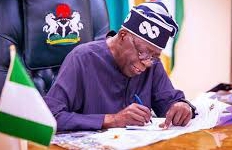
President Bola Tinubu spoke at the ongoing World Economic Forum in Riyadh, Saudi Arabia, on Sunday.
He emphasized that his administration’s decision to remove the fuel subsidy was necessary to avoid pushing Nigeria into bankruptcy.
Tinubu also highlighted the country’s belief in economic collaboration and inclusiveness with other nations to promote global stability. The panel session focused on Global Collaboration, Growth, and Energy for Development.
He said, “For Nigeria, we are immensely consistent with belief that the economic collaboration and inclusiveness are necessary to engender stability in the rest of the world.
“Concerning the question of the subsidy removal, there is no doubt that it was a necessary action for my country not to go bankrupt, to reset the economy and pathway to growth.”
Tinubu, on his inauguration on May 29, 2023, declared to the citizens his resolve to stop the payment of the fuel subsidy, saying “subsidy is gone.”
The Federal Government had introduced a subsidy to assist citizens in paying for fuel purchases at higher prices. However, this subsidy later became a problem, as it contributed to the high prices of commodities in the market, especially food items and transportation costs. This led to calls from Nigerians, stakeholders, and the international community for action to be taken to address the situation.
In his New Year message on January 1, 2024, the President admitted that the fuel subsidy payments by the FG were an “unsustainable financial burden” on the country. Although it was a tough decision to remove the fuel subsidy, it was necessary to improve the standard of living for the populace.
“It is going to be difficult, but the hallmark of leadership is taking difficult decisions at the time it ought to be taken decisively. That was necessary for the country. Yes, there will be blowback, there is an expectation that the difficulty in it will be felt by a greater number of the people, but once I believe it is their interest that is the focus of the government, it is easier to manage and explain the difficulties.
“Along the line, there is a parallel arrangement to really cushion the effects of the subsidy removal on the vulnerable population of the country. We share the pain across the board, and we cannot but include those who are vulnerable.
“Luckily, we have a very vibrant youthful population interested in discoveries by themselves, and they are highly ready for technology, good education committed to growth. We are able to manage that and partition the economic drawback and the fallout of subsidy removal,” he said.
Tinubu equally noted that the fuel subsidy removal brought about accountability, transparency, and physical discipline for the country.
Speaking on the exchange rate unification and the swinging rate of the Naira against other global currencies like the United States dollar, Tinubu said, “The currency management was necessary equally to remove the artificial elements of value in our currency. Let our local currency find its level and compete with the rest of the world currency and remove arbitrage, corruption, and opaqueness.
“That we did at the same time. That is a two-engine problem in a very template situation for the government, but we are able to manage that turbulence because we are prepared for inclusivity in governance and rapid communication with the public to really see what is necessary and what you must do.”