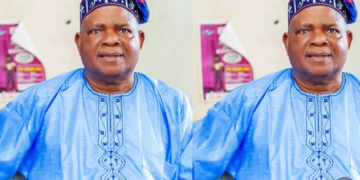
The Minister of State for Petroleum Resources (Oil), Dr. Heineken Lokpobiri, asserted that Nigeria is determined to navigate the transition from fossil fuel to cleaner and renewable energy without relying on aid or grants. Speaking at the 54th Annual Meeting of the World Economic Forum in Davos, Switzerland, Lokpobiri unveiled a robust energy transition plan, projecting a total of $3.1 trillion, with $1.9 trillion allocated for the overall energy transition and $1.2 trillion specifically earmarked for renewable energy by 2060.
In a social media post on Thursday, the Minister underscored the commitment of Nigeria, represented by himself, Vice President Kashim Shettima, and other global leaders, to responsible fossil fuel exploration, incorporating state-of-the-art technologies. He emphasized that the nation’s energy policies align with the expectations of the Organisation of the Petroleum Exporting Countries (OPEC), demonstrating Nigeria’s dedication to sustainable practices in the energy sector.
However, on the issue of transitioning from fossil fuels, Lokpobiri stressed that ”Africa, Nigeria in particular, will not rely on aids and grants to transition.
“Our 2060 projected energy transition plan and renewable energy plan stands at USD1.9 trillion and USD1.2 trillion respectively.”
His words, “At the 54th Annual Meeting of the World Economic Forum (Davos 2024), I seized the platform to outline our strategic initiatives, reinforcing Nigeria’s position as an attractive investment destination in the oil sector.
“Thus, I invited prospective investors to join us on this transformative journey, ensuring mutual prosperity and sustainable energy solutions.
“Alongside Vice President Kashim Shettima and global leaders, I emphasized our commitment to responsible fossil fuel exploration, leveraging cutting-edge technologies.
“I also highlighted the fact that our energy policies align with OPEC expectations, showcasing our dedication to sustainable practices.
“However, on the issue of transitioning from fossil fuels, I emphasised that Africa, Nigeria in particular, will not rely on aid and grants to transition.
“Our 2060 projected energy transition plan and renewable energy plan stands at USD1.9 trillion and USD1.2 trillion respectively.”
“To achieve the energy transition and renewable energy plans, the Minister stressed that there would be a need for “an increased investment in our oil and gas sector to bolster our economy and guarantee energy security”.
He added that with the large deposit of mineral resources, domestic control of the mining and production will yield more climate finance to Africa, and not aid or grant.
“To this end, the transition conversations should move towards trade and partnerships, and not just deadlines,” he stated.
To deliver on its climate target and energy transition plan, President Bola Tinubu, had earlier said that the country would have to spend $17.7bn annually.
Energy Transition and Investment Plans reflect how countries show they would build energy systems to support economic and social development and achieve net-zero emissions. Nigeria released its Energy Transition Plan in August 2022.
Net-zero means cutting greenhouse gas emissions to as close to zero as possible, while the remaining emissions are re-absorbed from the atmosphere by oceans and forests, among others.
This also aligns with the new energy world order, which is the changing landscape of the energy sector as renewable energy sources like solar, wind and water gain prominence, displacing the old energy world order dominated by fossil fuels.