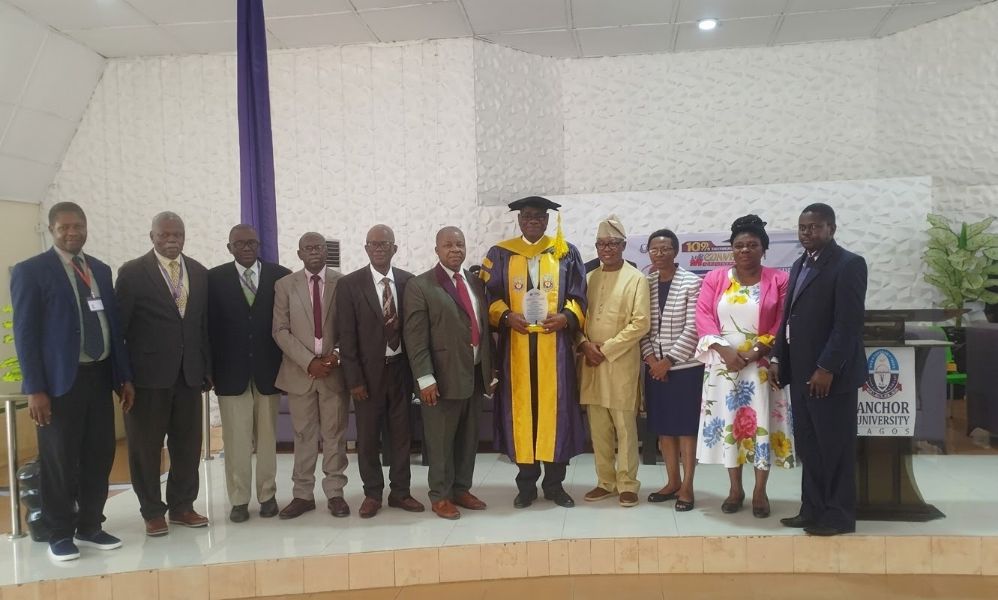
A former Vice-Chancellor, University of Lagos and Chairman, Governing Board, National Universities Commission (NUC), Prof. Oluwatoyin Ogundipe, has warned that as Africa approaches a major demographic turning point, with its population projected to reach about 2.5 billion by 2050, transactional leadership cannot address the continent’s development challenges.
He said Africa must embrace transformational leadership to turn its abundant natural and human resources into sustainable prosperity, stressing that political and administrative bargains would not provide lasting solutions to the continent’s problems.
Delivering the decennial lecture at Anchor University’s 6th and 7th Convocation Ceremony, Ogundipe spoke on the theme, “Anchor at 10: University Education, Transformational Leadership and the Future of Africa.”
Drawing on leadership theories and development research, he noted that despite its vast mineral resources and extensive uncultivated arable land, Africa continued to grapple with weak institutions, unemployment and overdependence on the export of raw materials.
He identified leadership and institutional weaknesses as major obstacles to the continent’s development, arguing that Africa needed leaders capable of building strong institutions and inspiring meaningful change.
Explaining the difference between transactional and transformational leadership, Ogundipe said transactional leadership, as discussed in the works of James MacGregor Burns and Bernard Bass, was largely based on an exchange of rewards for compliance.
While acknowledging the importance of clear rules, effective daily management and accountability, he argued that transactional leadership alone was inadequate for institutions and societies facing fundamental changes.
He warned that without a shift towards transformational leadership, Africa’s rapidly growing youth population could become a development burden rather than the demographic dividend it should be.
In contrast, he explained that transformational leadership inspired people to rise above personal interests by strengthening their values, aspirations and commitment to collective progress.
Describing leadership as a driving force behind institutional development, Ogundipe highlighted the four pillars of transformational leadership identified by Bass: idealised influence, inspirational motivation, intellectual stimulation and individualised consideration.
He explained that idealised influence involved earning people’s trust through integrity and personal example, while inspirational motivation required leaders to communicate a compelling vision capable of inspiring collective action.
Intellectual stimulation, he said, encouraged people to question existing assumptions, think creatively and develop innovative solutions, while individualised consideration involved investing in the personal and professional growth of others.
Against the backdrop of the emerging knowledge economy and the Fourth Industrial Revolution, characterised by rapid advances in artificial intelligence, robotics and biotechnology, Ogundipe urged universities to look beyond the award of certificates and prepare graduates for the realities of a changing world.
He cautioned that competence without character could produce corruption, while courage without conscience could lead to tyranny.
According to him, sustainable national development requires a combination of technical competence, digital skills and problem-solving abilities with moral reasoning, civic responsibility and spiritual values.
He challenged graduating students to shun shortcuts, uphold integrity and strive for excellence, urging them to compete globally, whether at home or abroad, while using their knowledge and skills to contribute to the development of their communities and alma mater.
Reflecting on Anchor University’s first decade and its journey towards its 20th anniversary, the NUC board chairman described university education and transformational leadership as two critical pillars for Africa’s future.
He said the continent’s prosperity would not happen by chance but would require deliberate planning, visionary leadership and sustained commitment.
Addressing the graduating students, Ogundipe said: “Congratulations. To the parents and guardians who invested in these young Joshuas, and if I may add, young Deborahs, thank you and well done.
“To the Chancellor, the Board of Trustees, the Council, the Management, staff and the entire Anchor University family, congratulations on a remarkable first decade. May the next ten years be even greater.”
Earlier, in his welcome address, the Vice-Chancellor of the University, Professor Samuel Oye Bandele, urged members of the university community and other stakeholders to give thanks to God for the institution’s 10 years of existence and achievements.
Speaking on the theme, “Let Us Praise God Together,” Bandele described the university’s decade-long journey as a testimony to divine intervention, provision, preservation and purpose.
He said the institution’s growth and achievements were not products of human effort alone but were made possible by God’s grace, goodness, guidance and protection.
The Vice-Chancellor also acknowledged the contributions of the university’s founder, Pastor (Dr) William Kumuyi, Founder and General Superintendent of the Deeper Christian Life Ministry, as well as the management, Board of Trustees, past and present Pro-Chancellors, staff and other stakeholders to the institution’s development.
He noted that establishing and sustaining a university was a demanding responsibility, adding that Anchor University had overcome several challenges through divine support.
Bandele expressed gratitude for the safety of students and the peaceful atmosphere on campus, reaffirming the institution’s commitment to its Christian foundation and mission.
He urged the graduating students, staff, management and guests to remain united in giving thanks to God, noting that the university’s achievements over the past decade called for humility and gratitude.
Also, the event featured the unveiling of a 500-page compendium titled: “Anchor University: A Decade of Monumental Advancement”, written by a former Registrar of the University, Pastor Moses Salami.
Reviewing the book, Professor Olusola Samuel Oyero, a communication scholar and Deputy Vice-Chancellor of the university, said the publication documented the establishment, growth and institutional development of Anchor University during its first decade.
He said the book traced the university’s journey from its inception in 2016 to 2026, highlighting the vision, planning and processes that shaped its establishment and subsequent development.
According to Oyero, the publication is organised into three sections: Preparation, Prosecution and Progression, providing a logical framework for understanding the different stages of the university’s development.
He described the book as a valuable historical record containing chronological accounts, statistical data, photographs and relevant documents.
These materials, he said, provided useful insights for researchers, university administrators and other stakeholders interested in the development and management of private universities in Nigeria.