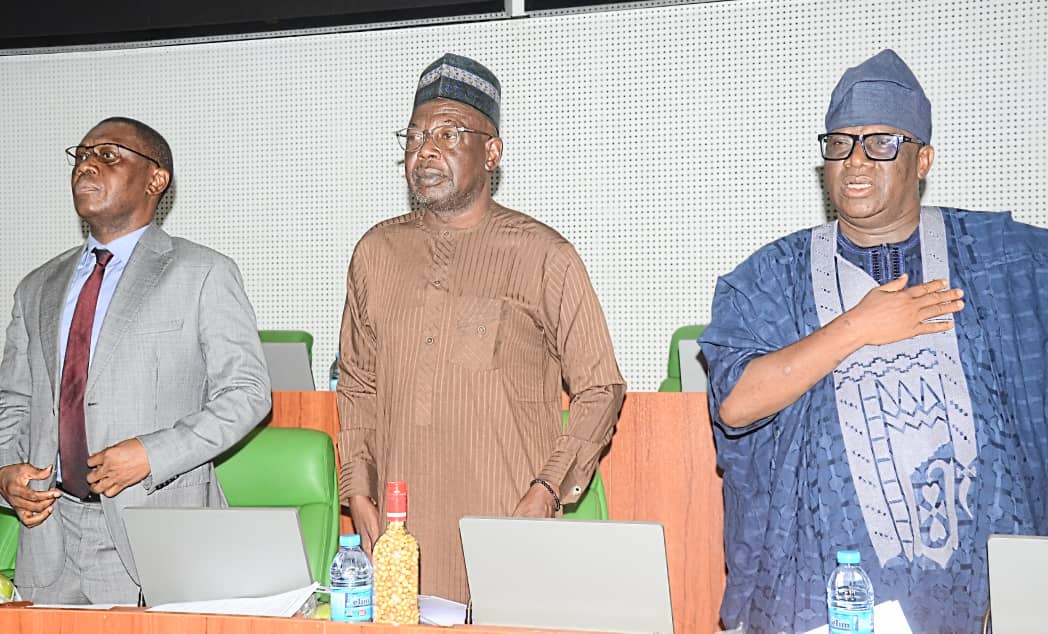
The Speaker of the House of Representatives, Hon. Tajudeen Abbas Monday, called for urgent modernisation of Nigeria’s law governing investment of trust funds, saying the 69-year-old Trustee Investment Act of 1957 can no longer protect beneficiaries in a modern economy.
Speaking at the public hearing on the Trustee Investment Act (Repeal and Enactment) Bill, 2026 in Abuja, organised by the House Committee on Capital Market, Abbas said the law carries a responsibility beyond financial management.
“The law governing the investment of trust funds carries a responsibility that extends beyond financial management. It concerns the protection of property, the preservation of family wealth and the security of those whose interests depend on the prudent management of assets entrusted to others,” he said.
“Behind every trust may be the inheritance of a child, the security of a widow, the resources of a charitable institution or the accumulated wealth of a family. The law must ensure that these interests are adequately protected.”
Abbas noted that the existing Act was enacted in a substantially different economic and financial environment, while capital markets have expanded, financial instruments have become more sophisticated and new opportunities for wealth creation have emerged.
“Nearly seven decades later, the investment landscape has changed considerably… Yet the legal framework governing trust investments has not kept pace with these developments. This makes reform both necessary and timely,” he stated.
He said the core challenge of the new bill is to strike the right balance between preserving trust assets and enabling reasonable returns.
“An excessively restrictive framework may deny beneficiaries legitimate opportunities for growth, while an inadequately regulated one may expose their assets to imprudent decisions and avoidable risks.”
According to him, the bill seeks to replace the outdated framework with a more comprehensive regime that expands permissible investment opportunities to reflect contemporary finance and allow greater diversification.
However, he warned that expanded investment freedom must be matched by strong safeguards. “Expanded investment freedom must be matched by strong safeguards, clear fiduciary responsibilities, effective risk management and appropriate regulatory oversight,” he said.
“The governing principle must remain unmistakable: trustees hold assets for the benefit of others, not for their personal advantage. Their decisions must therefore be guided by prudence, integrity, transparency and an overriding commitment to the interests of beneficiaries.
“Modernisation must never become a licence for speculation or a justification for exposing trust property to unreasonable risks.”
Abbas also linked the reform to Nigeria’s broader economic needs, saying the country requires substantial long-term capital to address its infrastructure deficit, expand productive capacity and stimulate enterprise.
“A credible framework for managing trust investments can contribute to deeper capital markets and more effective mobilisation of domestic resources. But this economic objective must always be pursued without compromising the rights and security of beneficiaries,” he noted.
He urged stakeholders at the hearing to bring their professional and technical expertise to bear on critical areas of the Bill, including proposed investment categories, diversification requirements, fiduciary obligations, professional delegation, regulatory oversight and beneficiary protection.
The speaker said the 10th House of Representatives is committed to modernising Nigeria’s legal and institutional framework, stressing that effective lawmaking requires rigorous scrutiny, informed debate and meaningful engagement.
“The objective should be legislation that is not merely contemporary in its outlook but practical, enforceable and capable of standing the test of time,” he said.
He assured participants that their submissions will receive due attention, adding that the success of the reform should be measured not simply by opportunities created, but by “the confidence it inspires, the assets it protects and the lasting value it delivers to beneficiaries.”
In his welcome address, Chairman of the House Committee on Capital Market and Institutions, Hon. Solomon T. Bob, said the Trustee Investment Act has become obsolete and must be replaced to reflect the realities of a modern capital market now worth over N80 trillion.
“Today, we gather to review a law that has governed trust investments in Nigeria since 1957 – 69 years ago,” Bob said.
“The Trustee Investment Act, Cap T22, LFN 2004, was made when Nigeria had only Federal Government bonds. Today, we have a sophisticated capital market worth over N80 trillion, pension assets over N30 trillion, and new asset classes from REITs to Infrastructure Funds to Green Bonds. The world has moved. Our law has not. This hearing is to correct that.”
Bob said the bill seeks to repeal and re-enact the Act with modern provisions to balance growth and safety of trust assets.
He said the bill seeks, amongst other things, an expanded investment universe (Clause 3): “To include corporate bonds, equities, collective investment schemes such as ETFs and REITs, infrastructure funds, real property, foreign investments via licensed custodians, private equity, regulated virtual assets, and ESG-compliant bonds.
“Diversification and safety (Clause 4): Introduces a 20 per cent rule – no more than 20 per cent of trust funds in a single issuer – to avoid concentration risk that has destroyed many family estates.
“Delegation with Responsibility (Clause 6): Allows trustees to delegate to professionals like fund managers and custodians but retains responsibility for selecting and supervising them”.