A former Minister of Foreign Affairs, Major-General Ike Nwachukwu (Retd) has re-echoed the call for a new Constitution that will reflect inputs and the true aspirations of Nigerians.
He reiterated that Nigeria stands in urgent need of a true people’s constitution, adding that the 1999 constitution, despite the many amendments it has undergone, remains inadequate in many respects.
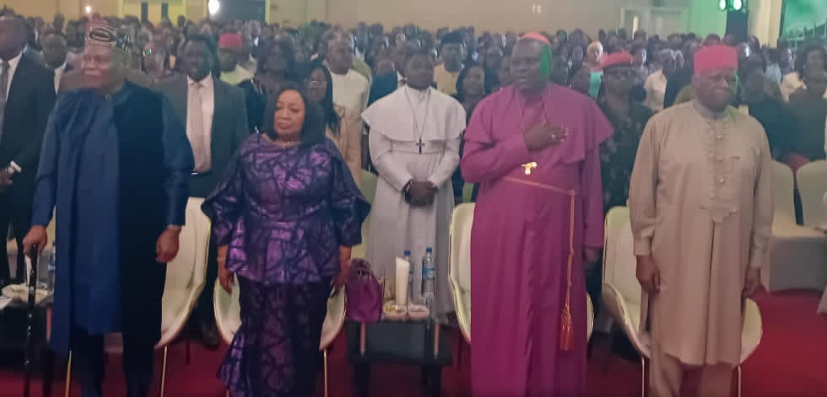
He spoke on Thursday during the 24th edition of Mike Okonkwo Annual Lecture in Lagos. The theme of the lecture was: ‘The Nigerian of Our Dream: Today’s Reality And A Responsible Pathfinder.’ The lecture and the presentation of prices to winners of the Mike Okonkwo Annual Essay Competition for Secondary Schools in Nigeria, were among the activities to mark the 80th birthday of Bishop Okonkwo.
Nwachukwu also called for the entrenchment of true federalism, adding that the fundamental rights of Nigerians to live and thrive anywhere within their nation must be guaranteed.
The retired general said that every well meaning Nigerian yearns for what is noble and just for the country, which according to him are true democracy, good governance, a constitution that reflects the people’s will. He added that they need accurate national census, genuine fiscal federalism, merit-driven competition, respect for federal character, and above all, the rule of law that guarantees justice, fairness and equity for all citizens.
He stated that these are the bonds that unite Nigerians as a nation.
Nwachukwu, who was the Chairman of the occasion, noted that Nigeria, is a land of immense promise, blessed with abundant resources and vibrant people. He, however, said that today’s reality often confronts the people with painful contradictions, extreme poverty amidst tremendous wealth, but growth and development amidst tremendous potential, and unity challenged by division.
He said that to bridge today’s gap requires a responsible pathfinder, leaders who rise above self-interest to chart a course for the common good.
Nwachukwu said: “The 1999 constitution, despite the many amendments it has undergone, remains inadequate in many respects. First, a hindrance to both economic growth and the full emancipation of our people. What our nation requires is a genuinely negotiated constitution, one that reflects the aspirations of our diverse ethnic nationalities, just as our founding fathers negotiated and agreed upon at independence in the immediate post-independence time of our country. The military court, when we came, took that down, and that has since been a problem for the country.
“Only such a constitution, freely discussed and agreed upon, can form the basis of a stable, united, and progressive country. I repeat, only such a constitution, freely discussed and agreed upon, can form the basis of a stable, united, and progressive Nigeria. Second, is the matter of entrenching true federalism in our national discourse, our national framework.
“The echoes of this demand have lingered in our politics for decades, yet the core remains vivid today as it was then. Federalism is not merely a political slogan. It is the enduring principle our forefathers envisaged for Nigeria.”
He added: “Enshrining genuine federalism in our constitution would guarantee resource control, empowering each federalist unit to develop at its own pace and in accordance with its own priorities. All Nigerian states are blessed with abundant resources, some even much more viable than oil. Granting them full autonomy over their resources would unleash innovation, stimulate expansive economic activities, and reduce independence on the center.
“I am of the opinion, and strongly so, that there is no un-viable state in Nigeria. What there is are states which have been denied their rights to develop using their God-given human and natural resources. I hear economists talk about this. Natural states are not viable, and so on and so forth. And as you know, our states, every state in this country, has got mineral resources, human resources. What it is, is we have a constitution that divides them from using their resources on building a strong country. We can’t all be the same. A man who lives in Tauranga Muda cannot expect to earn the same salary as a man in Lagos. The standards of living in Lagos are different.
“But therefore, with what they have in Tauranga Muda, in their state, they can develop their state, and they can have the annual work they earn, and live according to their standards. So therefore, what we need is to let our states have the autonomy, use their resources, build up a country. And you’ll be surprised that in a very short while, our country will boom. And all these problems about north and south, and how’s that, Yoruba and so on and so forth, will end. Because people will develop on their own steam, and will build a country in diversity and unity. Therefore, to realize this, the 1999 constitution must give way to a fresh document rooted in equity, justice, and true federal principles.”
Former Vice President, Prof Yemi Osinbajo (SAN) cautioned against corruption.
He spoke on ‘The Church of the Lord Jesus Christ As a responsible pathfinder, in attending the Nigeria of our dream.’
He said it was sad that some religious leaders were not preaching the true gospel.
He warned political, religious and business leaders against indulging in corrupt practices.
Osibanjo said: “I fear that we are not hearing the true gospel frequently enough on our pulpits, which will explain why despite the number of churches and religious institutions, we still have a society whose values cannot sustain a modern economy. We’re the elite of a society. When I say the elite, the political, the religious and business leaders have come to accept corruption as the rule. Whether it is to win elections or to win contracts or to win cases in court, our society appears to have accepted bribery and graft as a standard. And the lower levels of society copy the elites.
“So everywhere you go, cheating, pilfering, petty embezzlement from driver to shop assistant to the straight in man at the gate, everywhere. Saying, well, this is what all of the big people are doing. This was the kind of society, the kind of society that we’re experiencing today was the kind of society that Europe was before the Protestant Reformation.
“The gospel attacked corruption and cheating. It made it clear that no corrupt person can please God. And even those who knowingly take the benefits cannot please God either. The pulpits were aflame with a message that went down to the man in the market, cheating with his rigged skills. Or the magistrate that was taking a bribe, that without repenting, no amount of giving or offerings or tithes or fasting will be due him or her. Very clear.
“Today, what we hear from many of our pulpits is the gospel that is to the effect that the purpose of our faith is the attainment of wealth or at least physical or material well-being. And that this material well-being can be attained by a transactional process of giving, especially giving to the church institutions.”
The celebrant, Dr Mike Okonkwo, warned against tribal sentiments and inhibiting people from owning properties, discrimination and prohibiting people from living comfortably and without encumbrances in any part of the country. He stated that Nigerians should not be limited from achieving whatever good aspirations they have for themselves in any part of the country.
Okonkwo. who is the Presiding Bishop of The Redeemed Evangelical Mission (TREM), called for a Nigeria where the wealth of the nation is used judiciously for the overall wellbeing of the people.